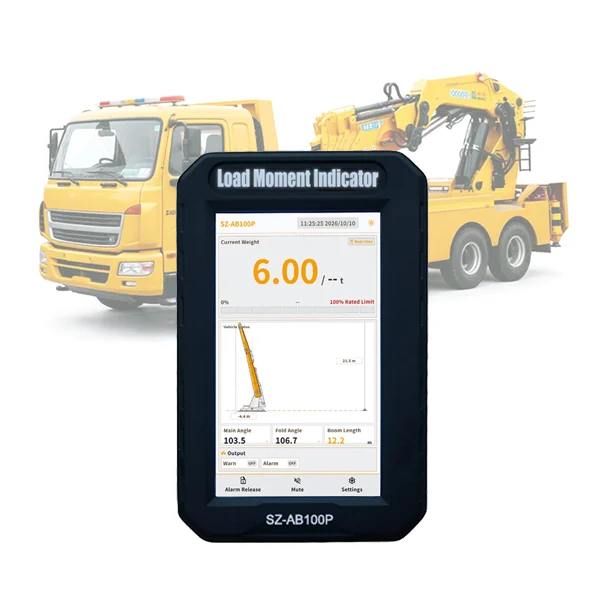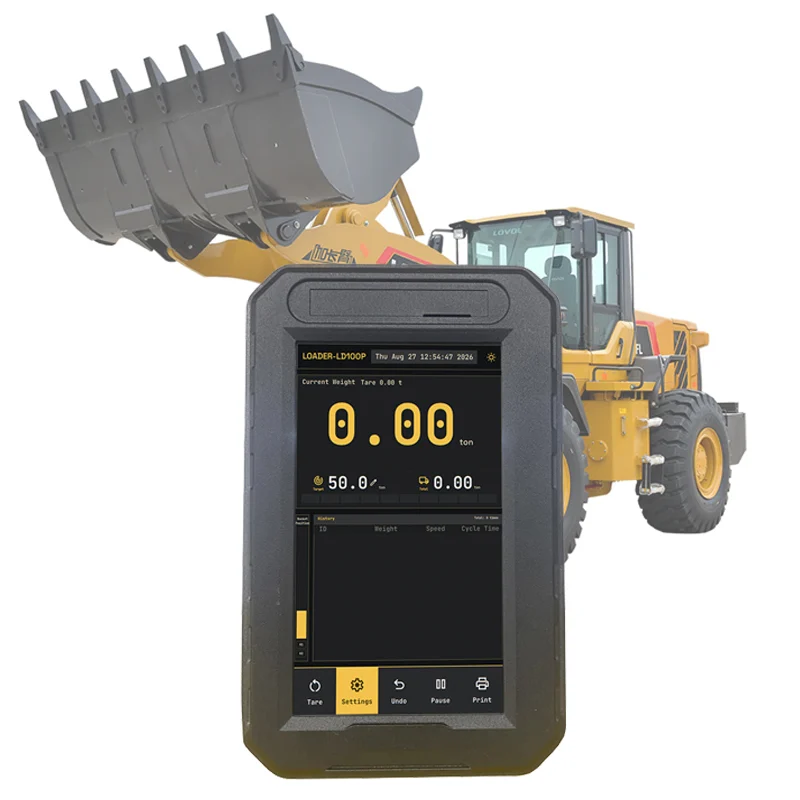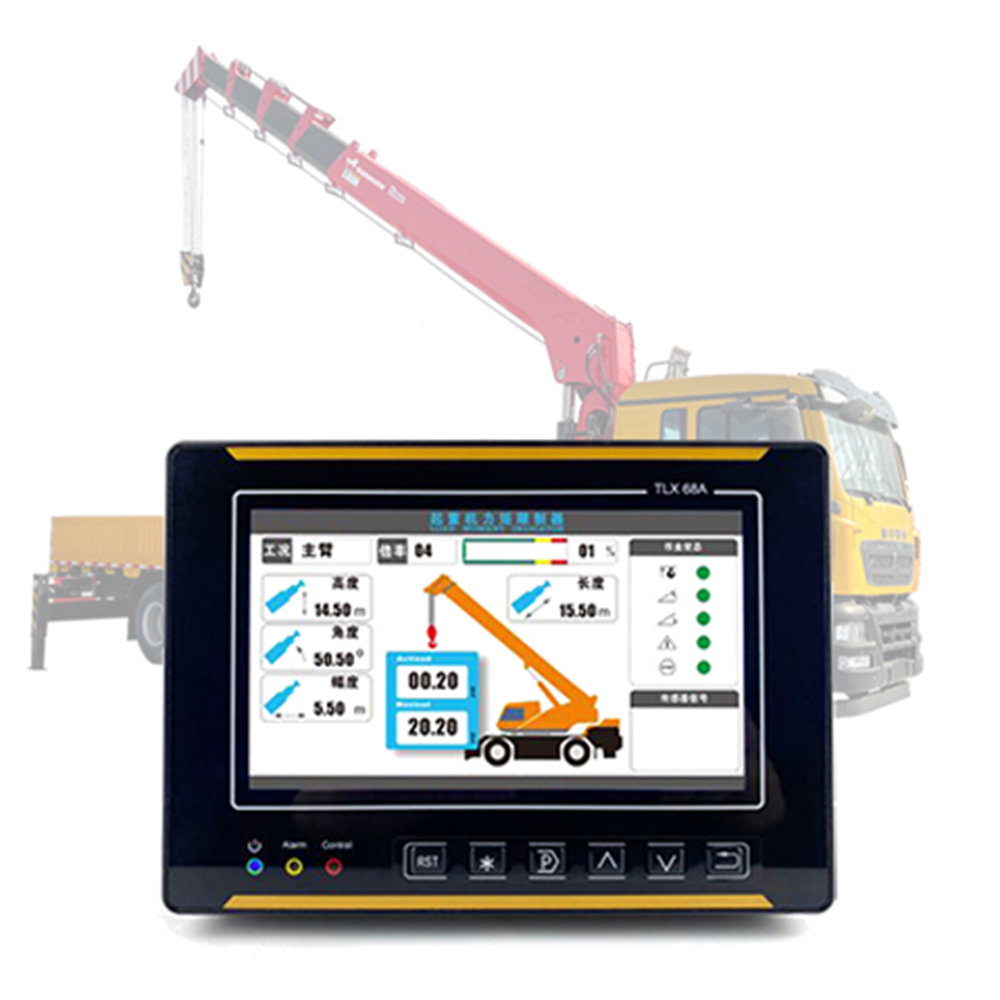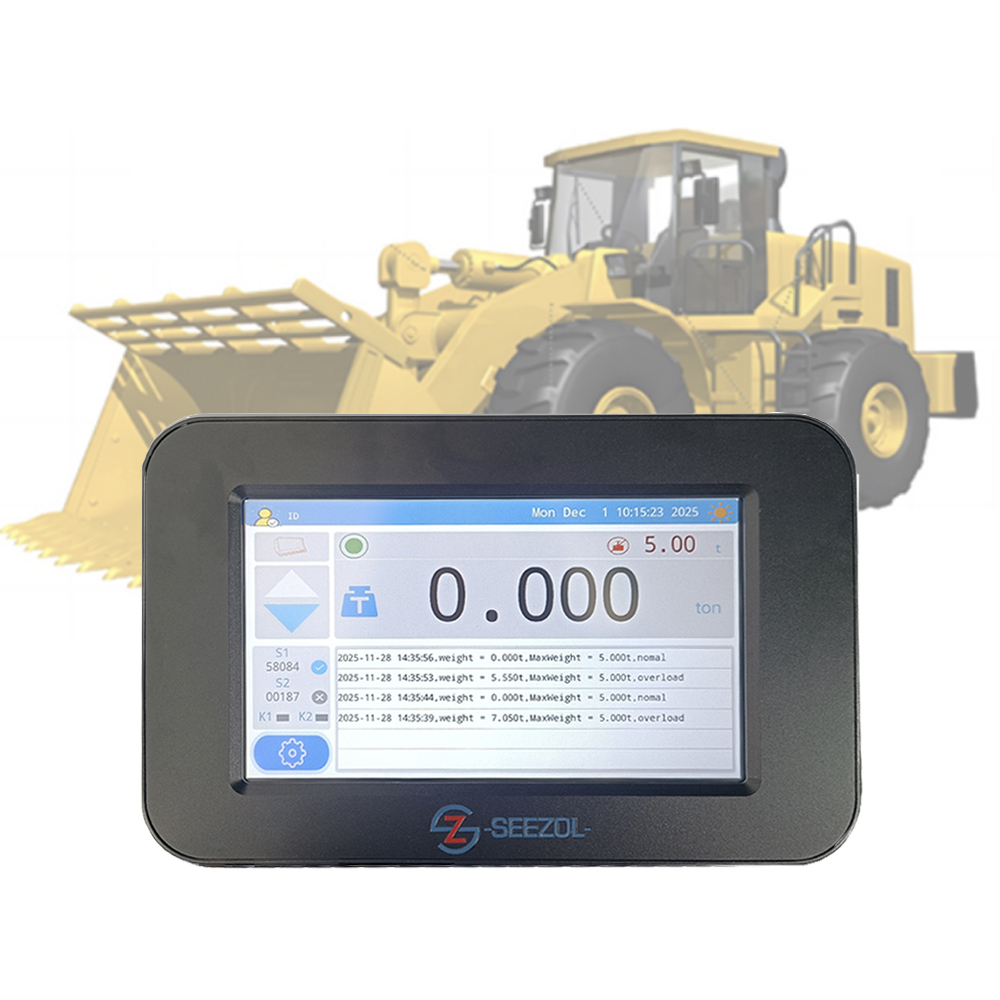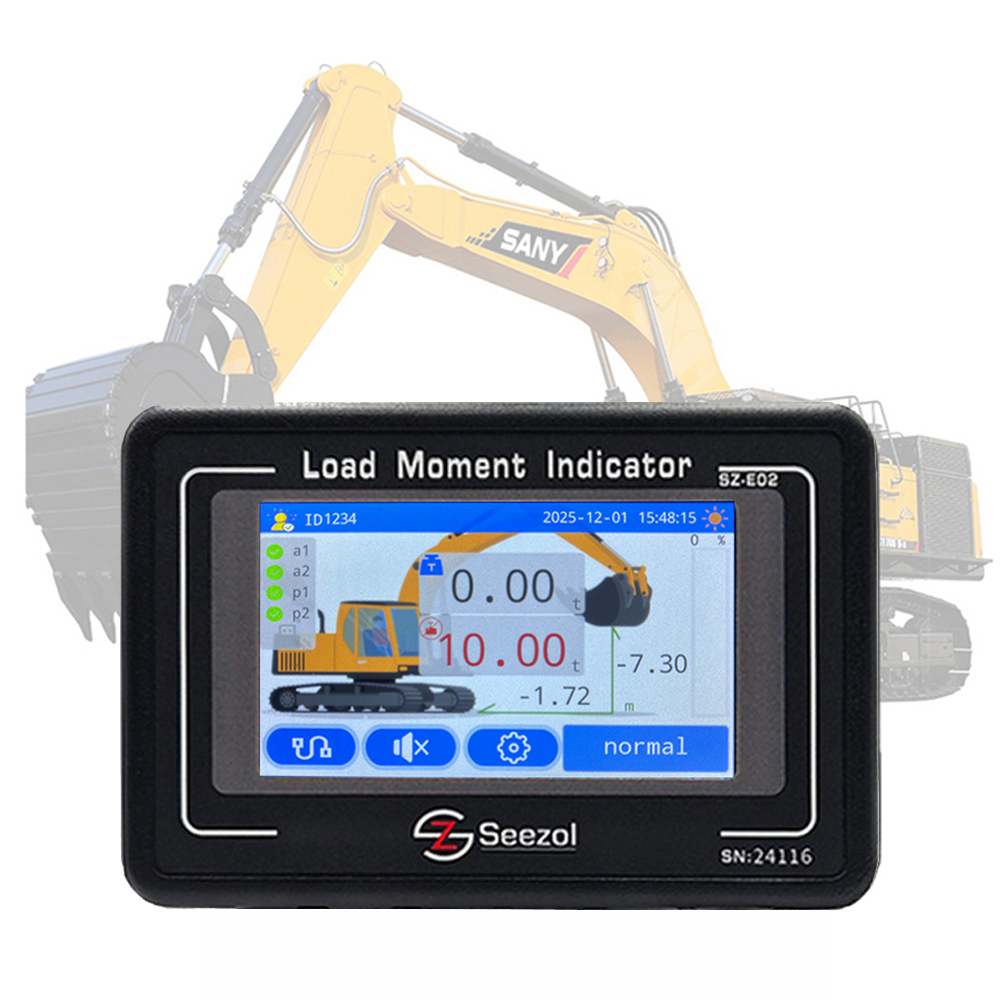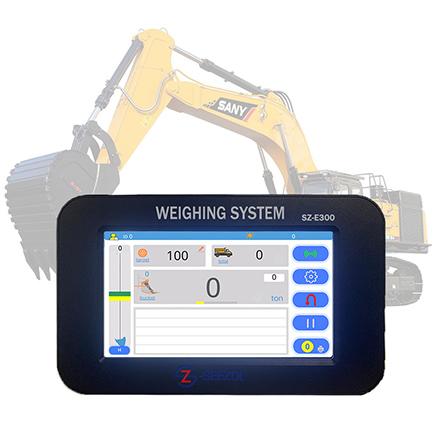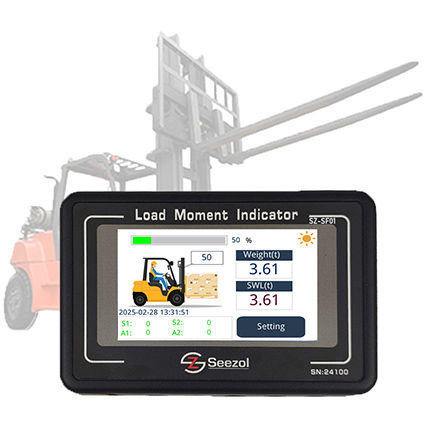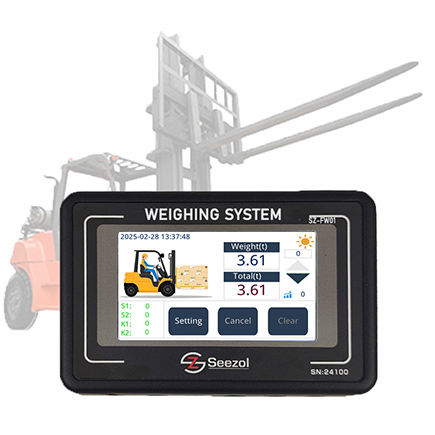
Si vous vous demandez comment choisir un indicateur de moment de charge (LMI) Qu'il s'agisse d'une grue, d'une pelleteuse ou d'une chargeuse sur pneus, ce guide vous guide dans votre choix à l'instar de nos ingénieurs de terrain : la machine d'abord, le catalogue ensuite. La réglementation en exige un, la police d'assurance en mentionne un, et le devis du fournisseur propose trois modèles différents à trois prix différents. Ce que les acheteurs découvrent trop tard, c’est qu’un LMI n’est pas un accessoire que l’on choisit dans les pages d’un catalogue. Il s’agit d’un système de mesure conçu sur mesure pour une machine spécifique : achetez le mauvais modèle et vous vous retrouverez avec un écran qui s’allume, des alarmes qui se déclenchent au mauvais moment, et un opérateur qui apprendra à ignorer les deux.
Ce guide correspond à la liste de contrôle que nous utilisons en interne pour adapter un système à l'engin d'un client — grues sur camion, grues sur chenilles, pelles hydrauliques, chargeuses et autres types d'engins moins courants. Il explique les questions auxquelles il faut répondre avant de comparer les prix, comment lire une fiche technique, ainsi que l'étape d'étalonnage qui détermine si le système sera utilisé ou discrètement mis hors service.
Le rôle réel d'un indicateur de moment de charge
Un LMI ne pèse pas directement la charge. Il mesure la géométrie et le effort hydraulique de chaque levage — angle de flèche, longueur de flèche, pression du vérin — calcule le moment en temps réel et le compare au tableau des capacités nominales enregistré dans le contrôleur. Lorsque la limite est proche, il avertit l'opérateur. Si celle-ci est dépassée, il interrompt les mouvements dangereux via un relais.
Si vous hésitez entre un indicateur et un dispositif à seuil de coupure uniquement, commencez par la différence entre un LMI et un limiteur de charge — La suite de ce guide part du principe que vous souhaitez mettre en place la chaîne de surveillance complète. Notre Pôle LMI « grue par grue » permet de regrouper la liste complète des machines en un seul endroit.
Étape 1 — Commencez par votre machine, pas par le catalogue
L'erreur la plus courante lors de l'achat consiste à se baser sur un seul chiffre : la capacité nominale. Deux grues de 25 tonnes peuvent nécessiter des chaînes de capteurs complètement différentes. Ce que le système doit regarder dépend de la structure de la machine, et non de son logo.
| Machine | Ce que le système doit surveiller | Plage typique | Système de référence |
|---|---|---|---|
| Grue sur camion / grue tout-terrain | Longueur de la flèche, angle de levage, pression au niveau du sabot | 10 à 100 t | SZ-M100 mobile crane LMI |
| Grue sur chenilles | Même chaîne, gamme plus étendue, tableaux spécifiques aux chenilles | jusqu'à 260 t | Grue sur chenilles LMI |
| Grue araignée / mini-grue sur chenilles | Posture en stabilisateur + moment multi-configuration | 0,8 à 20 t | Grue araignée SZ-SC01 LMI |
| Grue maritime et de navire | Couple sous l'effet du tangage et du roulis, étanchéité marine | varie | Grue de navire LMI |
| Pelleteuse | Pressions des vérins de flèche, de bras et de godet | 10 à 100 t | Indicateur de charge de l'excavatrice |
| Chargeuse sur pneus | Pression du vérin de levage + position de la gâchette sur le bras | 1 à 20 t | balance pour chargeuse sur pneus de troisième génération |
| Chariot élévateur / chariot télescopique | Charge sur le mât, moment de stabilité en hauteur | 2 à 25 t | Chariot télescopique LMI |
| Reachstacker | Moment de la flèche pour des centres de charge excentrés | 10 à 45 t | Indicateur de charge pour reachstacker |
| Poseur de conduites à flèche latérale | Moment de la flèche avec des charges dont le centre de gravité est décalé | jusqu'à 90 t | Indicateur de charge de la flèche latérale |
| Manutentionnaire | Couple en service continu sous des charges alternées | 10 à 50 t | Indicateur de charge pour chariot élévateur |
| Grue à flèche articulée | Compensation de l'angle d'articulation | 3 à 50 t | Flèche articulée LMI |
L'exemple d'une grue araignée utilisée en intérieur illustre bien pourquoi cela est important. Sa capacité nominale varie à chaque extension des stabilisateurs ; le LMI doit donc détecter posture de soutien, et pas seulement la géométrie de la flèche : une grue sur camion sans données relatives aux stabilisateurs ne peut pas protéger cette machine, quoi qu’en dise l’emballage.
Si vous gérez un mixte flotte, résistez à la tentation d'acheter un seul modèle pour tout. Une gamme plus large avec des tableaux de capacité configurables revient moins cher que trois systèmes incompatibles entre eux — mais seulement si la chaîne de détection reste adaptée à chaque châssis. Demandez au fournisseur de vous établir un devis par type de machine et de vous présenter le schéma de détection pour chaque unité, et pas seulement pour la première.
Étape 2 — Suivez la chaîne de détection. La fiabilité d’un indicateur de moment de charge dépend de celle de son capteur le plus faible ; il convient donc de vérifier la chaîne dans l’ordre.
La qualité d'un LMI dépend entièrement de celle de ses trois points de détection. C'est là que les systèmes bon marché rognent sur les coûts, et que les défaillances commencent.
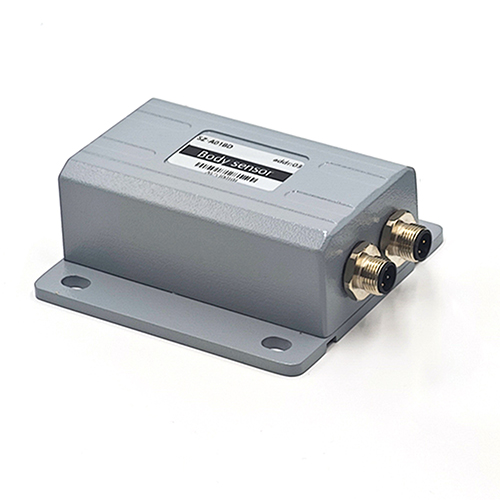
Le capteur d'angle est fixé sur le pivot de la flèche et mesure l'angle de luffage ; un capteur à deux axes détecte également l'inclinaison latérale, ce qui est important sur les châssis à chenilles et à patins. Le capteurs de pression hydrauliques (0–40 MPa, 4–20 mA, 0,51 TP4T FS) convertir la pression du cylindre en charge — la précision obtenue ici constitue la limite maximale de la précision de l'ensemble du système. Une longueur ou capteur de déclenchement ferme la chaîne sur les flèches télescopiques et les bras de chargeuse.
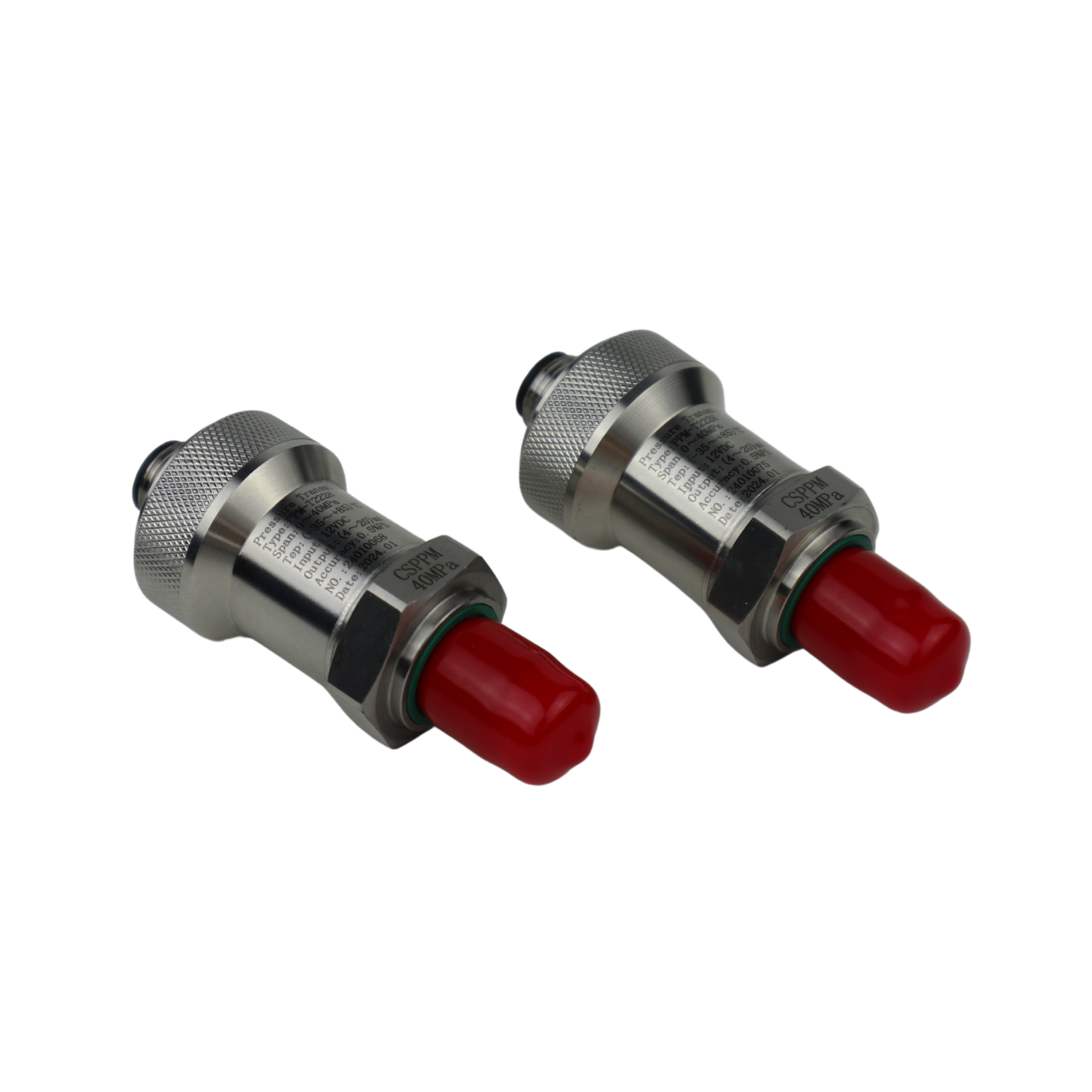
Trois paramètres environnementaux distinguent un capteur industriel d'un capteur destiné à une salle d'exposition : Étanchéité IP65 contre la poussière et les projections d'eau, un de −20 °C à +70 °C une plage de temps pour les travaux sur les conduites en hiver et les terrasses en été, ainsi qu’un câblage résistant aux interférences électromagnétiques (EMC) capable de supporter les perturbations du compartiment moteur. Demandez ces trois chiffres avant toute autre chose.
Étape 3 — Lisez la fiche technique comme un ingénieur
Les fiches techniques répertorient les mêmes éléments, mais dans un ordre différent. En voici un exemple concret — notre système de grue mobile SZ-M100 — avec les questions que chaque ligne devrait susciter.
| Ligne de spécifications | Valeur | Éléments à vérifier sur votre machine |
|---|---|---|
| Gamme | 5 à 260 t | Atteignez votre capacité maximale et la capacité minimale que vous souhaitez tout de même afficher — une seule gamme ne convient généralement pas à une flotte hétérogène |
| Erreur système | ±3% | Pour 100 t, cela représente ±3 t. Est-ce acceptable au regard de vos plans de levage et du règlement du chantier ? |
| Erreur d'affichage | ±5% | Ce que voit l'opérateur par rapport à ce que le contrôleur a calculé — c'est important pour les stagiaires |
| Protection de l'environnement | IP65 | C'est suffisant pour le lavage et la poussière ; pour les travaux portuaires et maritimes, il faudrait demander une protection plus élevée |
| Température | −20…+70 °C | Le pipeline d'hiver et la carrière du désert se trouvent tous deux à l'intérieur ; vérifiez vos valeurs extrêmes |
| Tension d'alimentation | 9 à 36 V CC | La conception à large plage d'entrée s'adapte aux baisses de tension au démarrage à froid et aux systèmes électriques des camions de 24 V |
| Sortie relais | 220 V CA / 3 A | Vérifiez bien qu’il permet effectivement de couper le circuit de commande de votre grue — demandez le schéma électrique |
Étape 4 — Conformité et documentation
Les autorités de régulation considèrent la protection contre les surcharges comme un équipement obligatoire, et non comme une option. La série de normes ISO 10245 pour les grues, la norme EN 13000 pour les grues mobiles et la norme chinoise GB/T 12602 décrivent toutes ce qu’un dispositif de limitation de charge doit détecter et faire. Si vos grues sont utilisées à l'étranger — flottes de location, contrats portuaires, projets EPC —, les documents administratifs accompagnent la machine : un certificat d'étalonnage, le tableau des capacités nominales utilisé par le contrôleur et les manuels rédigés dans la langue de l'opérateur. Demandez ces trois éléments au fournisseur dès la phase de devis, et non après la livraison.
Étape 5 — L'installation et le calibrage déterminent si l'appareil sera utilisé
Même un système correctement défini peut présenter des défaillances sur le terrain pour une seule raison : personne ne l'a étalonné. L'installation consiste à mettre en place les capteurs ; l'étalonnage permet au contrôleur d'apprendre à reconnaître ce que représentent le « zéro » et une « charge connue » sur votre machine.
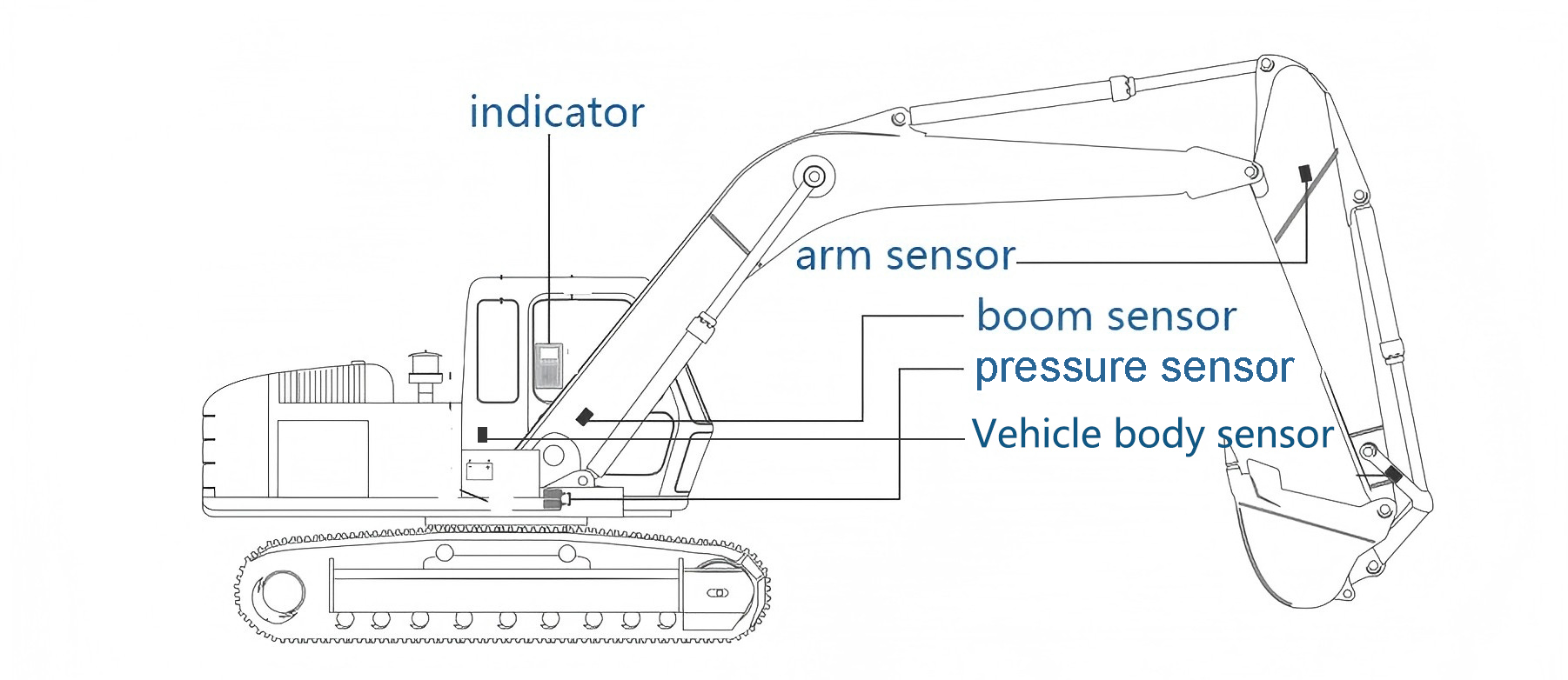 Disposition des capteurs sur une pelleteuse : emplacements des capteurs de position, du bras, de la flèche, de pression et de la carrosserie
Prévoyez une journée de travail pour le montage des capteurs et le câblage, puis une demi-journée pour l'étalonnage à l'aide de poids d'essai connus sur au moins trois points du diagramme de capacité. Après un remplacement de câble métallique, une réparation de flèche ou un changement saisonnier de température, revérifiez le zéro : un affichage non étalonné incite les opérateurs à se méfier du système, et c’est ainsi que les LMI finissent par être désactivés.
C'est aussi cette rigueur en matière d'étalonnage qui a permis à notre Mise en service de la flotte en Mongolie mesurable : la chargeuse sur pneus XCMG du client a fait l'objet d'un essai sur le terrain de 20 jours avec notre système de pesage de troisième génération avant que le client ne décide de l'installer sur l'ensemble de sa flotte.
Combien ça coûte ? — Un indicateur de moment de charge correctement choisi coûte bien moins cher qu’un seul accident dû à une surcharge et que les conséquences de ne pas en installer un.
Nous établissons des devis machine par machine plutôt que de publier une grille tarifaire, car la chaîne de détection varie selon le châssis. Une meilleure question à vous poser concernant votre budget : combien coûte un accident ? Une grue renversée, c'est une machine hors d'usage, un chantier à l'arrêt, une enquête et, dans le pire des cas, des blessés — des coûts qu'aucun devis de LMI ne pourra jamais égaler. Considérez cet achat comme une assurance dotée d'un écran, et non comme un simple accessoire.
Foire aux questions
Quelle est la différence entre un indicateur de moment de charge et un limiteur de charge ?
Un LMI affiche en continu le couple mesuré par rapport au tableau des capacités nominales ; un limiteur de charge (SLI) a pour fonction d'intercepter les mouvements dangereux dès qu'un seuil prédéfini est atteint. La plupart des contrôleurs SeeZol modernes combinent ces deux fonctions.
Quel est le degré de précision d'un indicateur de moment de charge de grue ?
Les valeurs typiques sont une erreur système de ±31 TP4T et une erreur d'affichage de ±51 TP4T par rapport à la pleine échelle — pour une capacité de levage de 100 t, la tolérance du système est de ±3 t. La qualité de l'étalonnage réalisée avec des charges d'essai connues est plus importante que les valeurs indiquées dans la fiche technique.
Un seul indicateur de moment de charge peut-il s'adapter à différents modèles de grues ?
Non. La chaîne de détection, le tableau des capacités et la logique d'alarme sont conçus spécifiquement pour chaque famille de machines : une grue à araignée nécessite une détection de la position des stabilisateurs ; une pelleteuse mesure les pressions des vérins plutôt que la longueur de la flèche.
Un LMI fonctionne-t-il à des températures extrêmes ?
Les systèmes industriels sont conçus pour fonctionner à des températures comprises entre −20 °C et +70 °C, avec un indice de protection IP65 : ils conviennent aussi bien aux travaux sur les canalisations en hiver qu'aux terrasses en été. En dessous de −20 °C, demandez une option d'écran adapté aux basses températures.
Combien de temps durent l'installation et le réglage ?
Environ une journée ouvrée pour les capteurs et le câblage, plus une demi-journée d'étalonnage à l'aide de poids d'essai connus. Les installations non étalonnées constituent la principale raison pour laquelle les opérateurs cessent de se fier à l'affichage.
À quelle fréquence faut-il réétalonner un indicateur de moment de charge ?
Effectuez un nouveau contrôle après tout remplacement de câble métallique, toute réparation de la flèche, toute modification structurelle ou tout transport sur de longues distances, et vérifiez le zéro au moins une fois par saison. Les flottes fonctionnant en plusieurs équipes doivent effectuer un contrôle supplémentaire en milieu d'année.
Un indicateur de moment de charge est-il identique à un système de pesage embarqué ?
Non. Un LMI est un dispositif de sécurité : son rôle est de comparer le couple à celui indiqué dans le tableau des caractéristiques nominales et d'empêcher tout mouvement dangereux. Un système de pesage est un outil de production : son rôle est de mesurer le poids des godets et des charges utiles à des fins commerciales et logistiques. Les chaînes de détection se recoupent, mais les objectifs de précision, les alarmes et les sorties de données diffèrent.
Le système permet-il d'enregistrer des données pour la gestion de flotte ?
Oui. Les contrôleurs actuels enregistrent l'historique local, et les plateformes de troisième génération, telles que le SZ-LD100P, transmettent les données de charge vers un tableau de bord dans le cloud afin de permettre une supervision multisite.
Les cinq erreurs d'achat les plus courantes
Après des années de modernisation des flottes, les mêmes cinq erreurs reviennent sans cesse dans les installations qui ont échoué. Aucune d'entre elles n'est liée au prix.
- Acheter uniquement au tonnage. Une grue tout-terrain de 25 t et une grue sur camion de 25 t partagent un même logo, mais pas une même chaîne de détection. Commencez par faire correspondre la structure.
- Considérer l'étalonnage comme facultatif. Le système est livré « préconfiguré » et fonctionne sans avoir été calibré. Au bout d'un mois, l'opérateur n'y prête plus attention.
- On ne tient pas compte des chiffres relatifs à l'environnement. Un écran conçu pour une utilisation en bureau ne résiste pas à son premier hiver ; les capteurs de pression, dont l'étanchéité n'est pas suffisante, se déréglent après le premier lavage.
- Acceptation d'un tableau de capacités générique. Le contrôleur doit fonctionner avec le schéma correspondant à la configuration de votre flèche et à votre plage de numéros de série, et non avec « un modèle similaire ». Demandez quelle version du schéma est fournie avec l'appareil.
- On oublie la chaîne d'approvisionnement en pièces détachées. Les capteurs tombent en panne avant les contrôleurs. Avant de signer, renseignez-vous sur le délai de livraison et le prix d'un capteur d'angle et d'un capteur de pression de rechange ; si la réponse est « nous allons vérifier », continuez à chercher.
Comment choisir un indicateur de moment de charge : la liste de contrôle en 5 points
- La machine d'abord : Adaptez la chaîne de détection à votre châssis, et non à la plaque d'indication de tonnage.
- Capteurs : Confirmer par écrit la conformité à la norme IP65, la plage de température de −20 à +70 °C et le câblage CEM.
- Fiche technique : Erreur système ±3% constatée par rapport à vos plans de levage réels.
- Conformité: Documents ISO 10245 / EN 13000 / GB/T 12602 fournis comme prévu dans le devis.
- Étalonnage : vérifiées à l'aide de poids d'essai, puis contrôlées à nouveau après toute intervention sur la corde ou la flèche.
Répondez à ces cinq questions et la comparaison des devis deviendra un jeu d'enfant. Si vous souhaitez obtenir un deuxième avis sur votre liste de machines, envoyez notre équipe d'ingénieurs vos modèles de grues, leurs capacités et votre environnement de travail : nous vous ferons parvenir une proposition de configuration dans un délai d’un jour ouvré.