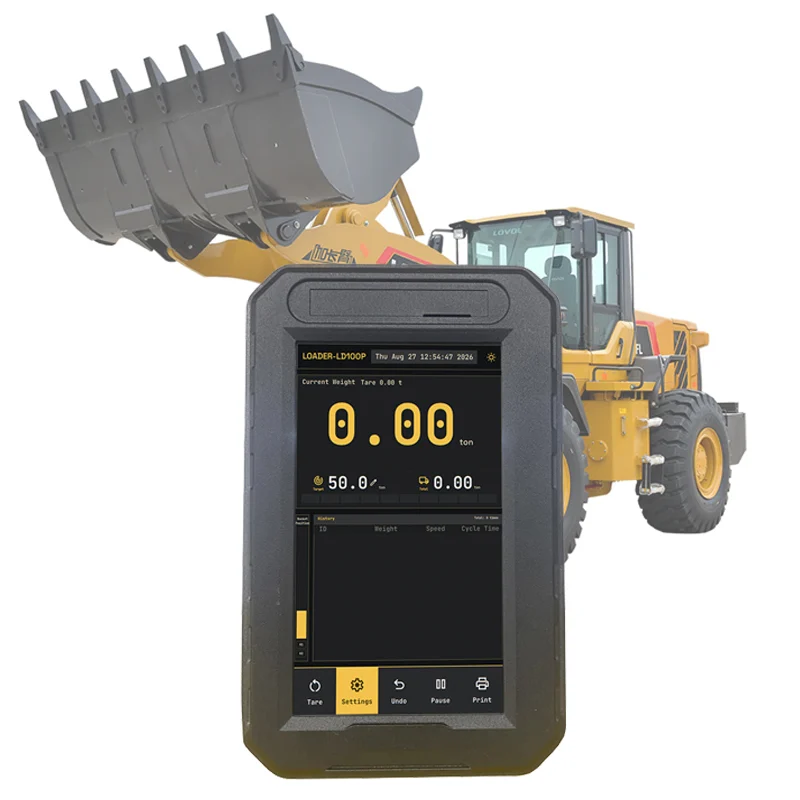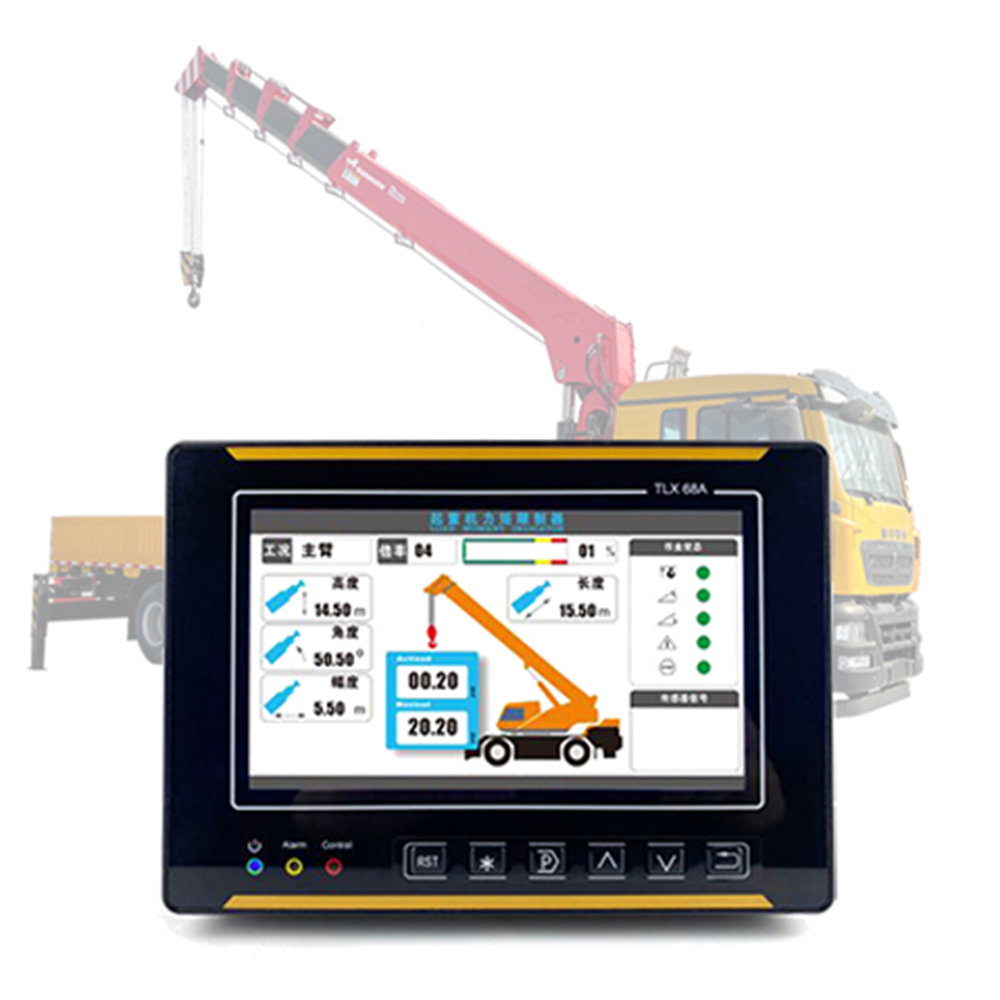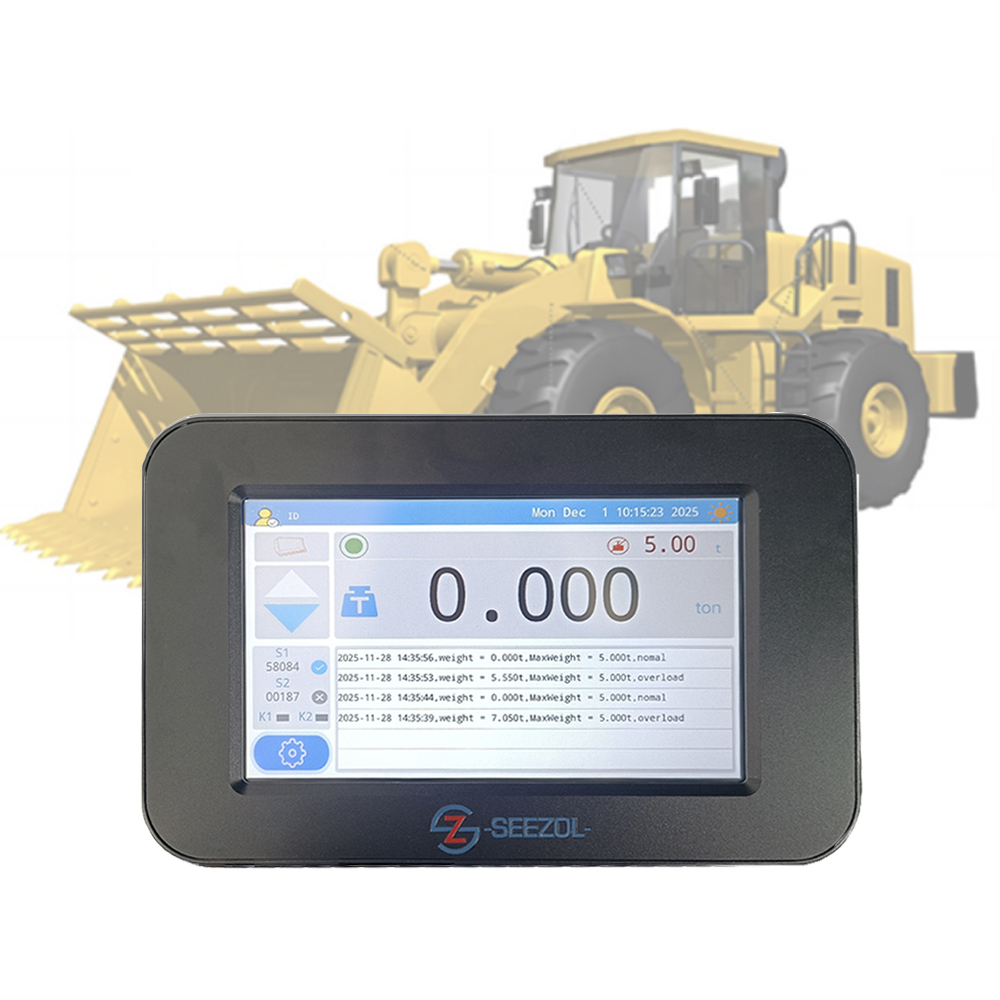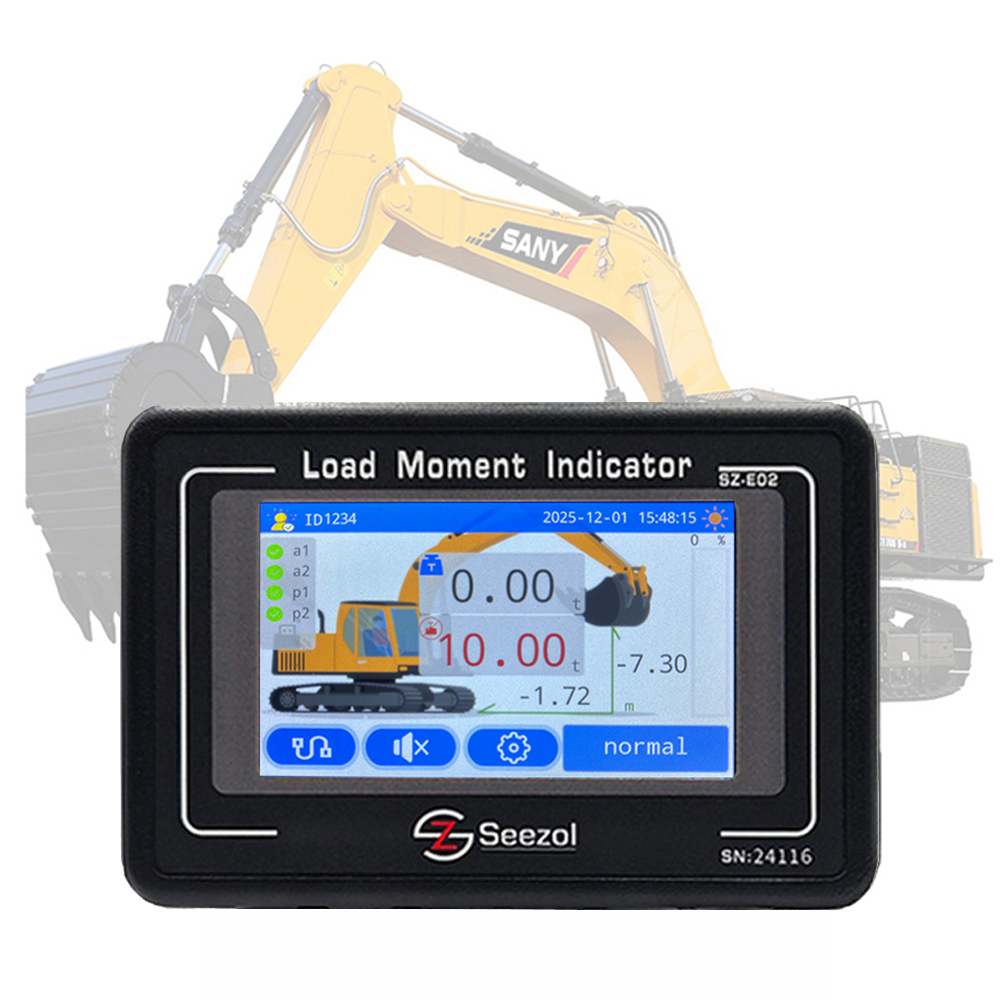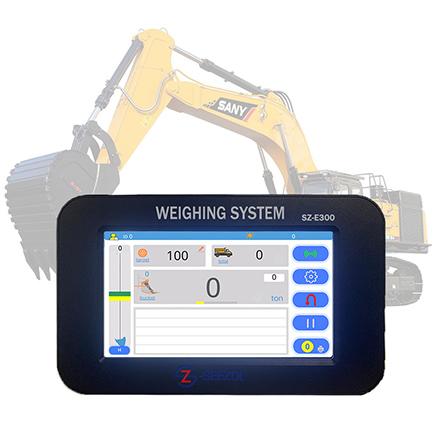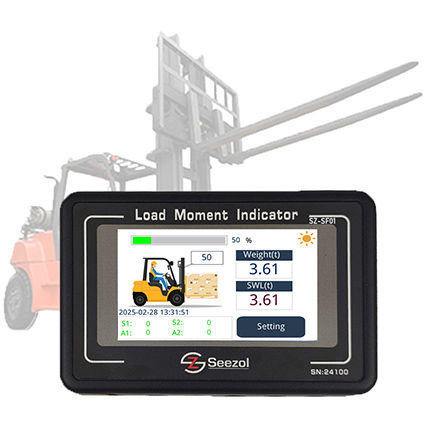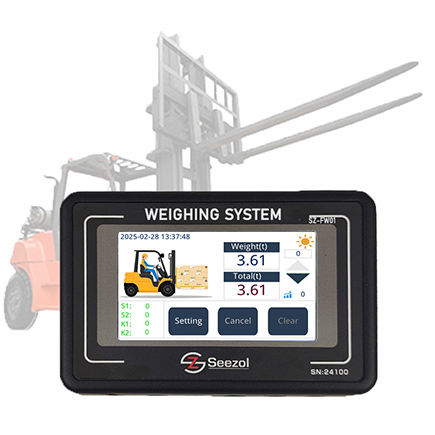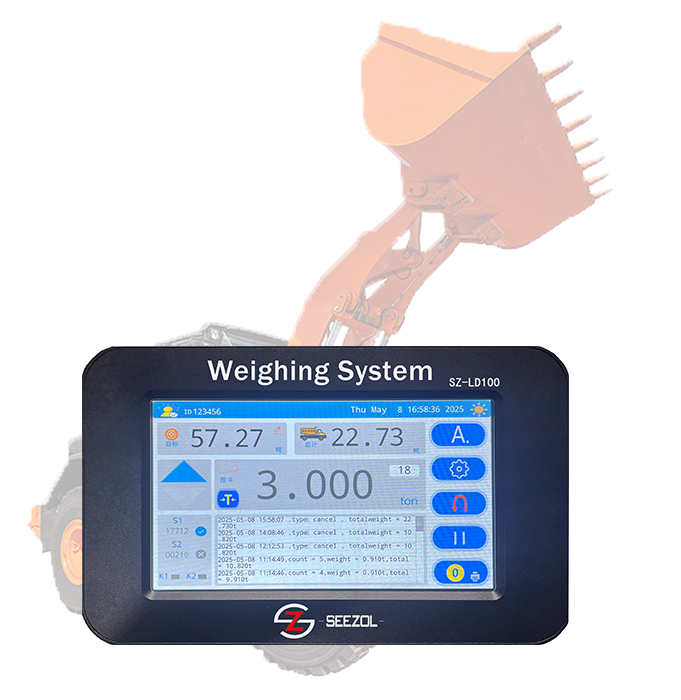
A Load Moment Indicator (LMI) continuously monitors load weight, boom angle, working radius, and rated capacity on mobile cranes, triggering visual and audible alarms — and automatic cutoff — when the crane approaches overload. A Safe Load Indicator (SLI) provides a simpler layer of load monitoring, typically measuring only hoist line tension against a pre-set limit. This article compares LMI, SLI, RCI, and RCL systems across sensor types, calculation methods, regulatory standards (OSHA, ASME B30.5, EN 13001, GB/T 12602), calibration requirements, pricing ranges, and retrofit feasibility, with a decision framework for procurement teams.
TL;DR — Quick Answer: Which System Do You Need?
A Load Moment Indicator is the most comprehensive crane safety monitoring system available. It calculates the complete lifting moment — load weight multiplied by working radius — and compares it against the crane’s rated capacity chart in real time. If the crane exceeds 90% of rated capacity, the LMI issues a warning alarm; at 100%, it triggers automatic lockout on most modern systems.
A Safe Load Indicator, by contrast, provides a simpler safety threshold. It monitors the force on the hoist line and compares it to a single pre-set load limit. It does not account for boom angle, working radius, or the crane’s full capacity chart.
| Feature | LMI (Load Moment Indicator) | SLI (Safe Load Indicator) | RCI (Rated Capacity Indicator) | RCL (Rated Capacity Limiter) |
|---|---|---|---|---|
| What it measures | Load weight + boom angle + working radius + line parts | Hoist line tension only | Hoist line tension vs rated capacity chart | Hoist line tension with automatic lockout |
| Calculation | Full moment: Load × Radius | Simple threshold comparison | Load vs capacity chart (no radius) | Load vs capacity with cutoff |
| Sensors required | Load cell, angle sensor, length sensor, pressure transducers | Single load cell or line tension sensor | Load cell + capacity chart lookup | Load cell + capacity chart + relay cutoff |
| Alarm levels | 90% warning, 100% alarm, 110% lockout (configurable) | Pre-set threshold alarm | Warning at rated capacity threshold | Warning + automatic load cutoff |
| Automatic cutoff | Yes (most systems) | No (warning only) | Some models | Yes |
| Typical application | Telescopic boom mobile cranes, crawler cranes | Tower cranes, simpler lifting equipment | Rough terrain cranes | Overhead/traveling cranes |
| Regulatory requirement | Required for most crane types under ASME B30.5 | Required under certain national standards | Required on specific crane types | Required on overhead cranes in many jurisdictions |
| Cost range (USD) — system hardware only | $1,250–$11,500 (varies widely by brand) | $800–$5,000 (varies by configuration) | $1,500–$4,000 | $1,200–$3,500 |
| Calibration frequency | Every 12 months (minimum); after any major repair | Every 12 months | Every 12 months | Every 12 months |
The short answer: If you operate a mobile crane with a telescopic boom, you need an LMI. If you operate a tower crane or simpler lifting setup, an SLI or RCL may be sufficient. If you operate in the United States, OSHA and ASME B30.5 set the baseline — but your specific requirements depend on crane type, jurisdiction, and application.
What Is a Crane Load Moment Indicator (LMI)?
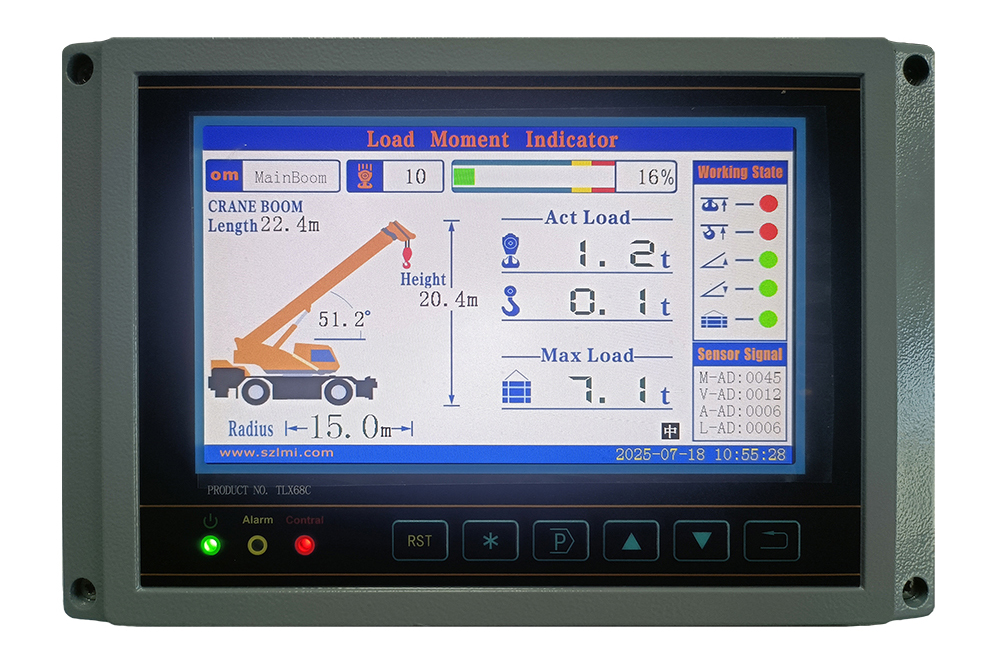
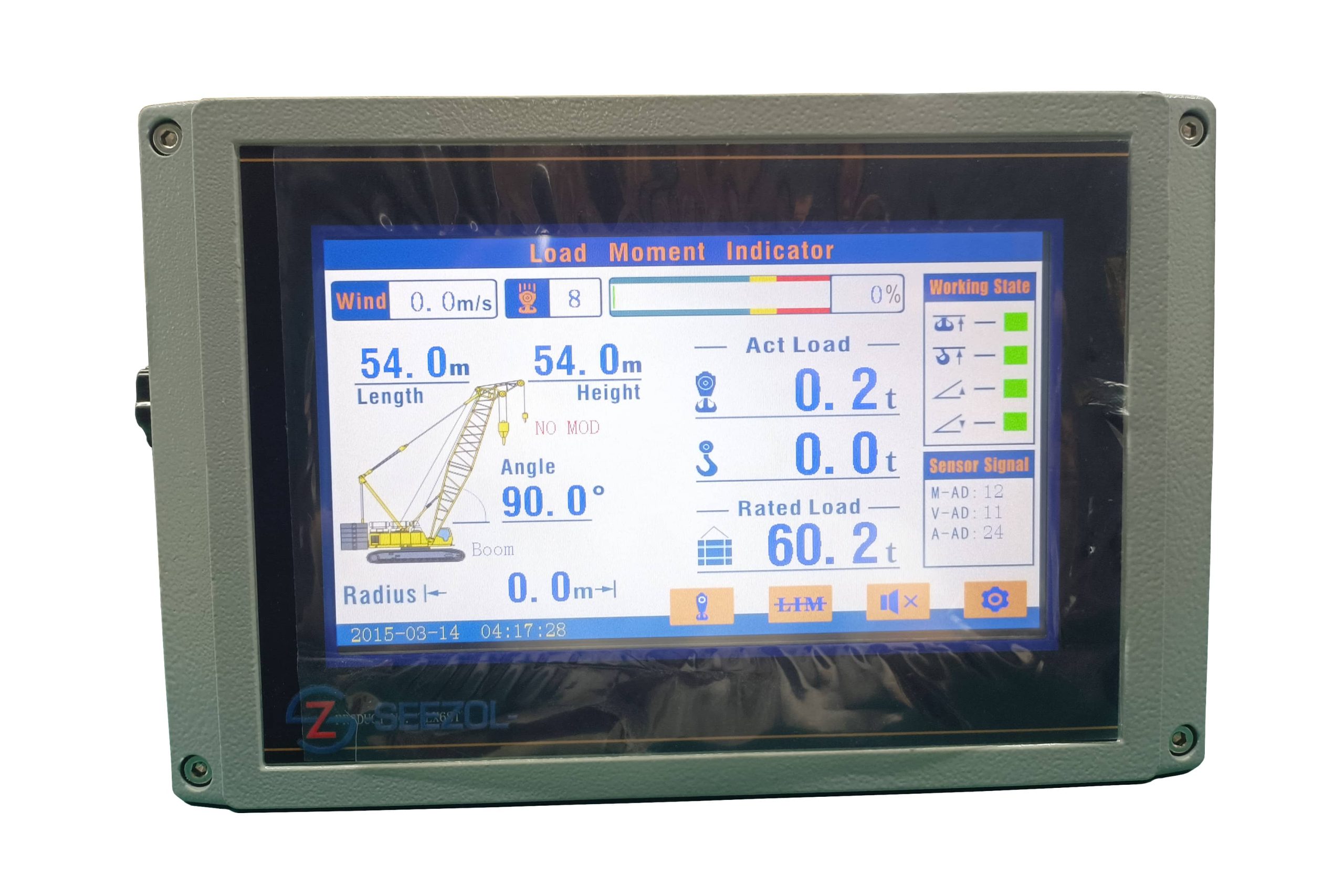
A Load Moment Indicator (LMI) is an electronic safety system that continuously monitors and calculates the complete lifting moment of a crane in real time. It measures load weight, boom angle, boom length, and working radius — then compares these values against the crane manufacturer’s rated capacity chart to determine whether a lift is within safe limits.
LMI systems are sometimes called Automatic Moment Limiters (AML) or Automatic Boom Load Indicators (ABLI), depending on the manufacturer and region. The terminology varies, but the function is consistent: prevent the crane from operating outside its structural or stability limits.
What LMI Actually Measures
The LMI continuously collects data from multiple sensors installed on the crane:
- Load weight — measured via load cells installed at the boom head, hoist drum, or wire rope dead end
- Boom angle — measured by an inclinometer (tilt sensor) mounted on the boom
- Boom length — measured via string pot sensors, rotary encoders, or ultrasonic sensors on telescoping booms
- Working radius — calculated from boom length and boom angle (not measured directly)
- Line parts — the number of wire rope lines supporting the load (manual input or auto-detected)
The onboard computer takes these five inputs and performs the core calculation:
Load Moment = Load Weight × Working Radius
It then compares the actual load moment against the maximum rated load moment from the crane’s load chart. If the ratio exceeds the alarm threshold (typically 90%), the LMI alerts the operator.
Why LMI Matters: The Physics Behind Crane Failures
A crane does not fail simply because a load is “too heavy.” It fails because the load moment exceeds the crane’s structural or tipping capacity. A 10-ton load at 5 meters radius (50 tonne-meters) has the same destabilizing effect as a 25-ton load at 2 meters radius (50 tonne-meters). Without an LMI, the operator must manually reference load charts, account for boom angle, calculate radius, and make real-time safety decisions — a process that introduces human error, especially under time pressure or poor visibility.
According to the U.S. Bureau of Labor Statistics, crane-related fatalities averaged 42 per year between 2011 and 2017 (BLS Census of Fatal Occupational Injuries, 297 total crane deaths over 7 years). While not all of these incidents involved LMI failure, overloaded or unstable lifts are consistently cited as a primary contributing factor.
What Is a Crane Safe Load Indicator (SLI)?
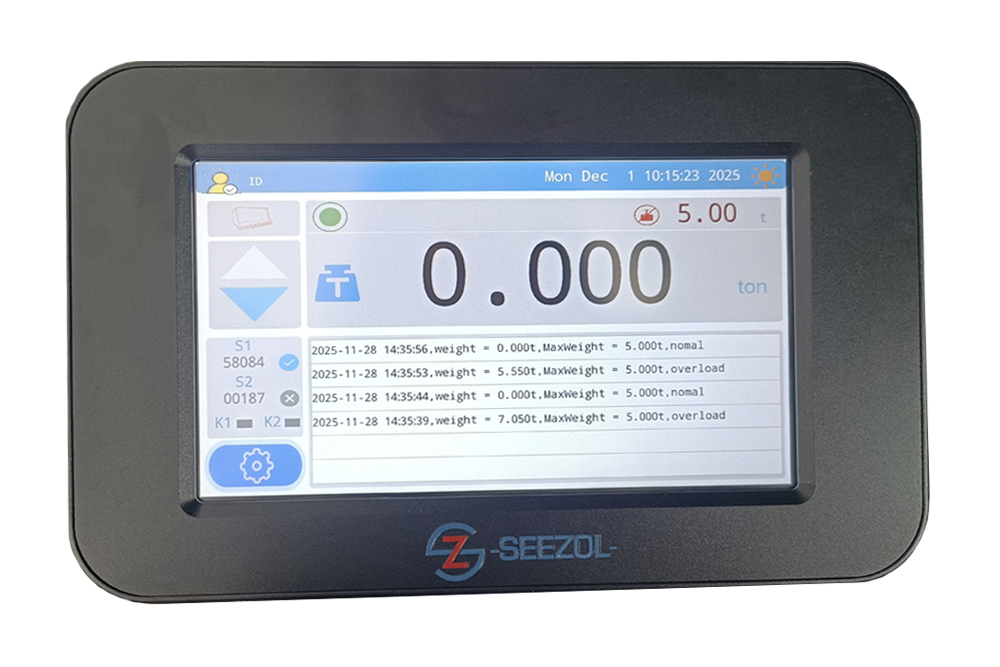
A Safe Load Indicator (SLI) is a simplified load monitoring device that measures the force on the hoist line and alerts the operator when the load exceeds a pre-set threshold. Unlike an LMI, the SLI does not calculate the full lifting moment — it provides a single-threshold warning based on tension measurement alone.
SLI systems are also referred to as Automatic Safe Load Indicators (ASLI), Anti-Two-Block devices (when specifically preventing two-blocking), or simply “load indicators” in some markets. The key distinction is that an SLI provides indication and warning only — it does not typically engage automatic lockout or cutoff.
How SLI Differs From LMI
The fundamental difference is calculation scope. An SLI answers one question: “Is the load on the hoist line exceeding the pre-set limit?” An LMI answers a more complex set of questions: “Is the crane’s entire lifting configuration — load, angle, length, and radius — within the safe operating envelope?”
| Parameter | LMI | SLI |
|---|---|---|
| Load weight measurement | Yes | Yes |
| Boom angle monitoring | Yes | No |
| Working radius calculation | Yes | No |
| Boom length tracking | Yes | No |
| Capacity chart lookup | Yes | No |
| Automatic lockout | Yes | No (warning only) |
| System complexity | High | Low |
| Sensor count | 3–5 sensors | 1 sensor |
| Installation time | 2–5 days | 2–8 hours |
Where SLI Is Still Used
SLI systems remain common in:
- Tower cranes: Where jib geometry is fixed and radius is the primary variable (often monitored by a separate system)
- Small overhead cranes: Where load capacity is fixed and only weight monitoring is needed
- Markets with less stringent regulations: Where LMI is not yet mandated by local standards
- Legacy equipment: Where retrofitting a full LMI system is impractical or cost-prohibitive
However, the global trend is toward LMI as the baseline safety standard. The European EN 13001 series and the Chinese GB/T 12602 standard both require moment-based load monitoring for most crane types. The OSHA 29 CFR 1926 Subpart CC regulations in the United States require load monitoring devices on most crane types used in construction.
LMI vs SLI vs RCI vs RCL — The Complete Comparison
The crane industry uses at least four different acronyms for load monitoring systems, and the confusion between them causes specification errors, compliance gaps, and sometimes safety incidents. This section provides the definitive comparison.
Sensor Architecture Comparison
LMI: Requires 3 to 5 sensors working together — a load cell (for weight measurement), an inclinometer (for boom angle), a string pot or encoder (for boom length), and potentially a pressure transducer (for hydraulic cylinder pressure on some systems). All sensor data feeds into a central processor that performs the moment calculation in real time.
SLI: Requires only 1 sensor — a load cell or line tension sensor installed at the hoist line, boom head, or hoist drum. The sensor compares the measured tension against a manually configured threshold. No angle, radius, or length data is collected.
RCI (Rated Capacity Indicator): Requires a load cell plus a capacity chart lookup. The RCI measures the hoist line tension and compares it against a stored capacity table, but it does not automatically account for working radius the way an LMI does. The operator must manually input or confirm boom configuration.
RCL (Rated Capacity Limiter): Functions similarly to an RCI but adds an automatic lockout feature. When the measured load reaches or exceeds the rated capacity for the current configuration, the RCL engages a relay that prevents further load hoisting. Common on overhead and traveling cranes.
Decision Flowchart: Which System Does Your Crane Need?
- Is the crane a mobile crane with a telescopic boom (truck crane, rough terrain, all terrain, crawler)? → LMI required
- Is the crane a tower crane with variable jib radius? → LMI or dedicated tower crane monitoring system (many tower cranes use a combination of moment monitoring and anti-collision systems)
- Is the crane a fixed-capacity overhead crane (bridge, gantry, jib)? → RCL or SLI may be sufficient, depending on jurisdiction
- Is the crane a legacy model without OEM load monitoring? → Aftermarket LMI retrofit is the most reliable option
- Does your jurisdiction require compliance with ASME B30.5, EN 13001, or GB/T 12602? → Check the specific standard for your crane type
How Load Moment Indicator Systems Work — Components and Calculation
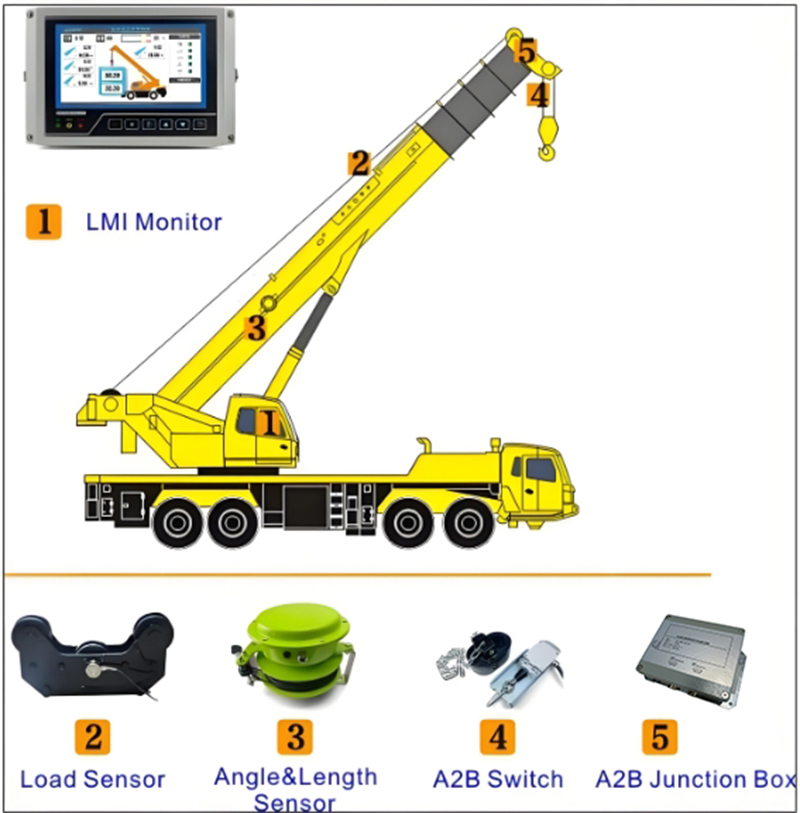
Understanding the technical operation of an LMI system helps procurement teams specify the right configuration and evaluate vendor claims accurately. This section breaks down the hardware architecture and the calculation methodology.
System Architecture
A modern LMI system consists of four functional layers:
Layer 1 — Sensor Array:
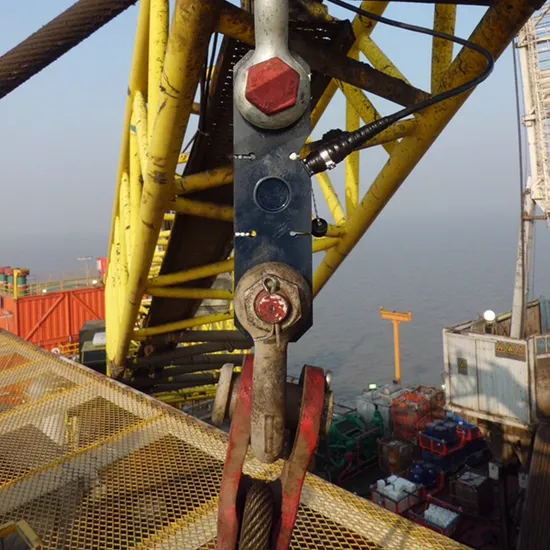
- Load cell (compression type): Installed between the boom head sheave block and the boom tip, or at the hoist drum. Measures the actual force on the hoist line. Typical accuracy: ±1% of full scale.
- Inclinometer (tilt sensor): Mounted on the boom body. Measures boom angle relative to horizontal, typically in the range of -5° to +85°. Accuracy: ±0.5°.
- String pot sensor (linear position sensor): Mounted along the telescoping boom sections. Measures boom extension length. Accuracy: ±0.5% of full stroke.
- Pressure transducer: Installed on the boom lift hydraulic cylinder. Measures cylinder pressure to derive boom angle as a secondary or primary input on some systems.
Layer 2 — Processing Unit:
The central processing unit receives all sensor inputs and performs the load moment calculation with a response time of 50 milliseconds or less (as specified by systems like SeeZol LMI). It stores the crane’s load chart in non-volatile memory and compares the calculated moment against the rated capacity in real time.
Layer 3 — Display Unit:
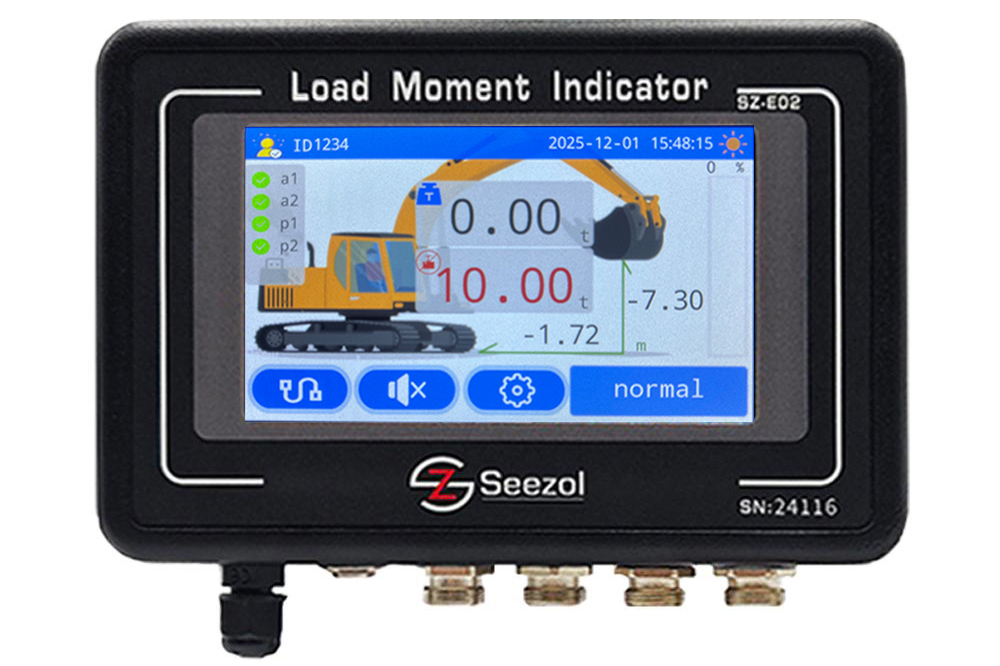
An operator-facing display panel mounted in the cab shows:
- Current load weight (in kg, lbs, or tonnes)
- Current working radius (in meters or feet)
- Current boom angle (in degrees)
- Current boom length (in meters or feet)
- Percentage of rated capacity (as a bar graph or numerical display)
- Alarm status indicator
Layer 4 — Alarm and Cutoff System:
- Pre-warning alarm (typically at 90% of rated capacity): Amber/yellow indicator light + audible tone
- Full alarm (at 100% of rated capacity): Red indicator light + continuous audible alarm
- Automatic lockout (at or above 100%, configurable): Hydraulic lockout relay prevents further load hoisting and, on some systems, prevents boom lowering (which would increase radius and worsen the overload condition)
The Load Moment Calculation
The core formula is straightforward:
Load Moment ™ = Load Weight (t) × Working Radius (m)
Working radius is derived from boom length and boom angle:
Working Radius (m) = Boom Length (m) × cos(Boom Angle)
For example:
- Boom length: 30 m
- Boom angle: 60°
- Working radius: 30 × cos(60°) = 30 × 0.5 = 15 m
- Actual load: 20 tonnes
- Load moment: 20 × 15 = 300 tm
- Rated capacity at 15 m: 320 tonnes (from load chart)
- Capacity utilization: 300 / 320 = 93.75% → Pre-warning alarm triggers
This calculation is performed continuously — with a system response time of 50 milliseconds or less — and the result is updated on the operator display in real time.
Regulatory Requirements — OSHA, ASME B30.5, EN 13001, and GB/T 12602
Load monitoring requirements vary significantly by region, and non-compliance carries legal, financial, and safety consequences. This section maps the key regulatory frameworks that mandate or recommend LMI/SLI systems.
United States — OSHA and ASME
OSHA 29 CFR 1926 Subpart CC (Cranes and Derricks in Construction) requires that cranes used in construction operations be equipped with a device that prevents the crane from exceeding its rated capacity. Specifically:
- 1926.1412(d)(1): The operator must not exceed the rated capacity of the crane
- 1926.1412(d)(2): The crane must be equipped with a load chart (or device that provides equivalent information)
- Load monitoring devices are required for most mobile crane configurations used in construction
ASME B30.5-2022 (Mobile and Locomotive Cranes) Section 5-3.2 requires:
- Load moment indicators on all new crawler, truck, and locomotive cranes
- The LMI must display load weight, boom angle, radius, and percentage of rated capacity
- Alarm activation at not more than 100% of rated capacity
- Automatic lockout capability at or above rated capacity
ASME B30.5 does not explicitly require LMI on all rough terrain cranes, but most manufacturers install them as standard equipment due to market demand and insurance requirements.
European Union — EN 13001 Series
EN 13001-3-1:2012 (Cranes – General Design – Limit States and Verification) and EN 13001-3-2:2012 (Separation Distances) establish the design and verification framework for crane load monitoring.
EN 13135:2001 (Cranes – Equipment) specifies that cranes must be equipped with load monitoring and limiting devices appropriate to the crane type and application.
Key requirements:
- Tower cranes: Must have moment monitoring devices
- Mobile cranes: Must have load monitoring proportional to the crane’s risk assessment
- The CE marking process requires documented load monitoring compliance
China — GB/T 12602-2022
GB/T 12602-2022 (Safety Devices for Lifting Machinery — Load Moment Indicator) is China’s national standard for crane LMI systems. It specifies:
- Technical requirements for LMI sensors, processors, and display units
- Performance requirements including accuracy, response time, and environmental durability
- Calibration and testing procedures
- Classification of LMI systems by accuracy grade (Grade 1 and Grade 2)
China’s standard is one of the most prescriptive LMI standards globally, specifying detailed sensor accuracy requirements and environmental testing conditions (temperature range, vibration, EMC compliance).
Regional Requirements Summary
| Region | Primary Standard | LMI Required? | SLI Sufficient? | Key Notes |
|---|---|---|---|---|
| USA (Construction) | OSHA 1926 Subpart CC + ASME B30.5 | Yes (most mobile cranes) | No for mobile cranes | Enforcement through OSHA inspections |
| USA (General Industry) | OSHA 1910.180 | Yes (crawler, locomotive, truck cranes) | Limited applicability | Older standard, less specific on LMI |
| European Union | EN 13001 + EN 13135 | Yes (risk-based) | May be sufficient for low-risk | CE marking required |
| China | GB/T 12602-2022 | Yes (most crane types) | No | Most prescriptive standard globally |
| Australia | AS 2550.1 | Yes (most crane types) | Limited applicability | Aligns with ASME in many areas |
| India | IS 3177 / IS 4573 | Varies by crane type | Common on older cranes | Standards in transition |
| Middle East | Varies (often ASME or EN adopted) | Depends on adopted standard | Varies | Project-specific requirements |
Calibration and Maintenance — What the Manuals Don’t Tell You
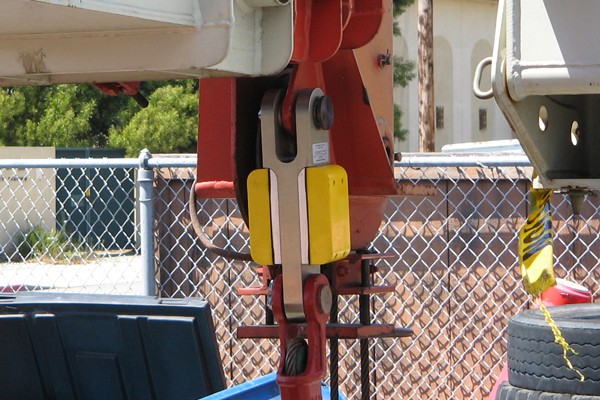
An LMI system is only as reliable as its calibration. A miscalibrated load cell or a drift in the angle sensor can cause the system to under-read load moment — exactly when accurate monitoring matters most.
When Calibration Is Required
Calibration must be performed:
- At initial installation — before the system is commissioned for use
- Every 12 months — minimum annual calibration interval per ASME B30.5 and most national standards
- After any major repair — structural repair to the boom, load path components, or sensor mounting
- After any sensor replacement — new load cells, angle sensors, or string pots require individual and system-level calibration
- After a crane incident — any event involving overload, sudden load drop, or structural impact
- After extended storage — cranes in storage for 6+ months should be recalibrated before returning to service
Calibration Procedure Overview
A standard LMI calibration involves three stages:
Stage 1 — Sensor Calibration (Individual):
- Load cell: Calibrated against a known test load at multiple points (typically 25%, 50%, 75%, and 100% of rated capacity)
- Angle sensor: Calibrated at 0°, 30°, 45°, and 60° using a precision inclinometer reference
- Length sensor: Verified at full retraction, 50% extension, and full extension
Stage 2 — System Calibration (Integrated):
- Known test loads are lifted at various boom configurations
- The LMI reading is compared to the actual test load (measured by a certified crane scale)
- Adjustments are made to the processor calibration factors
- Tolerance: typically ±3% of the actual load per ASME B30.5
Stage 3 — Alarm and Cutoff Verification:
- The alarm thresholds are verified at the specified percentage points (90%, 100%, 110%)
- The automatic lockout function is tested by lifting a load that intentionally exceeds the rated capacity
- The system must prevent further hoisting within the specified response time
Common Calibration Errors That Compromise Safety
Based on field experience with crane warning system installations and recalibrations, the most common issues are:
- Zero-point drift: The load cell’s zero reading shifts over time due to temperature changes, vibration, or sensor aging. If not corrected during calibration, the system will under-read or over-read all loads by a constant offset.
- Incorrect boom length input: On systems where boom length is manually entered (rather than auto-detected), operators sometimes input the wrong value — especially after boom extensions or retractions.
- Load chart mismatch: The processor’s stored load chart does not match the actual crane configuration (e.g., after adding counterweight, changing boom configuration, or installing a jib).
- Angle sensor mounting error: If the inclinometer is not precisely aligned with the boom axis, all angle readings will be offset, causing incorrect radius calculations.
- Wire rope weight not accounted for: The LMI must account for the weight of the wire rope itself, especially on long boom configurations where the rope weight is significant relative to the load.
Can You Retrofit LMI or SLI on an Older Crane?
Yes, in most cases — but the feasibility depends on the crane type, age, and available sensor mounting points. Aftermarket LMI retrofit kits are commercially available from multiple manufacturers and can be installed on most crane models manufactured in the last 30 years.
Retrofit Feasibility by Crane Type
| Crane Type | Retrofit Feasibility | Typical Cost (Installed) | Lead Time |
|---|---|---|---|
| Telescopic boom mobile crane | High — most common retrofit target | $3,000–$7,000 (hardware); $10,000–$50,000 (full project) | 3–7 days |
| Crawler crane | High — sensors mount to existing load paths | $3,500–$8,000 (hardware) | 4–8 days |
| Rough terrain crane | High — compact installation | $2,500–$6,000 (hardware) | 2–5 days |
| Tower crane | Moderate — depends on existing instrumentation | $4,000–$10,000 (hardware) | 5–10 days |
| Overhead/traveling crane | High — RCL retrofit is straightforward | $1,200–$3,500 | 1–3 days |
| Lattice boom crawler crane | Moderate — requires specialized sensor mounting | $4,000–$9,000 (hardware) | 5–10 days |
Key Retrofit Considerations
- Sensor compatibility: The retrofit kit must include sensors compatible with the crane’s mechanical configuration (e.g., telescoping vs. lattice boom, hydraulic vs. cable luffing)
- Load chart availability: The retrofit processor must be programmed with the correct load chart for the specific crane model, configuration, and counterweight setup. This data must come from the crane manufacturer.
- Power supply: The LMI system requires a stable 12V or 24V DC power supply. On older cranes, the electrical system may need upgrading to support the additional load.
- Structural assessment: Before retrofitting, the crane should undergo a structural assessment to ensure the existing load path components are compatible with load cell installation.
- Regulatory notification: In many jurisdictions, retrofitting a safety system requires notification to the relevant regulatory authority and may trigger a new inspection or certification requirement.
Choosing the Right System — Decision Framework for Procurement Teams
Selecting the right load monitoring system requires balancing regulatory compliance, operational requirements, crane type, and budget. This framework guides procurement teams through the key decision points.
Step 1: Identify Your Regulatory Baseline
The first question is not “which system is best?” but “which system is required?” Your regulatory baseline depends on:
- Geography: Which national or regional standard applies?
- Crane type: What type of crane are you equipping?
- Application: Construction, general industry, port, mining?
- Contract requirements: Do your client contracts specify particular standards?
If you operate in the United States on construction sites, ASME B30.5 and OSHA 1926 Subpart CC define your minimum requirements. If you operate in the EU, EN 13001 and EN 13135 apply. If you operate in China, GB/T 12602-2022 is mandatory for most crane types.
Step 2: Match System Capability to Crane Complexity
| Crane Complexity | Recommended System | Why |
|---|---|---|
| Simple fixed-capacity overhead crane | RCL or SLI | Only weight monitoring needed; capacity is fixed |
| Variable-capacity overhead crane | RCI or RCL | Capacity varies with configuration; chart lookup needed |
| Single-configuration mobile crane | LMI (entry-level) | Moment monitoring required; fewer variables |
| Multi-configuration mobile crane | LMI (full-featured) | Multiple configurations, counterweight options, jib attachments |
| Tower crane with variable jib | Dedicated tower crane monitoring | Moment + anti-collision + wind speed monitoring |
| Crawler crane with lattice boom | LMI with lattice boom kit | Specialized sensors for lattice boom configurations |
Step 3: Evaluate Vendor Capabilities
When evaluating LMI/SLI vendors, assess:
- OEM compatibility: Does the system integrate with your specific crane brand and model?
- Certification: Does the system meet the applicable standard (ASME, EN, GB)?
- After-sales support: Is calibration and maintenance available in your region?
- Spare parts availability: How quickly can replacement sensors and components be delivered?
- Data logging: Does the system record lift data for compliance documentation?
Step 4: Budget Planning
Budget the total cost of ownership, not just the initial purchase:
| Cost Component | LMI System | SLI System |
|---|---|---|
| Equipment (hardware) | $1,500–$5,000 | $500–$1,500 |
| Installation labor | $1,000–$3,000 | $300–$1,000 |
| Initial calibration | $500–$1,500 | $200–$500 |
| Annual calibration | $400–$1,200/year | $200–$500/year |
| Replacement sensors (over 10 years) | $1,000–$3,000 | $300–$800 |
| 10-Year Total Cost of Ownership | $5,400–$16,700 | $1,700–$4,800 |
The higher cost of an LMI system is justified by the broader protection it provides — it monitors not just the load, but the entire lifting configuration, including the stability and structural factors that cause the majority of crane incidents.
Common Mistakes in Load Monitoring (and What Happens When They Fail)
Load monitoring systems save lives — but only when they are properly specified, installed, calibrated, and maintained. The following are the most common mistakes observed in crane operations, and their consequences.
Mistake 1: Relying on SLI Where LMI Is Required
An SLI tells you the load weight. It does not tell you whether that load is within the crane’s safe operating envelope at the current boom angle and radius. Using an SLI on a telescopic boom mobile crane is like driving a car with only a speedometer but no fuel gauge, no temperature gauge, and no warning lights — you know one variable, but not the ones that actually determine whether you are about to have a problem.
Mistake 2: Ignoring Calibration Intervals
An LMI that has not been calibrated in 24 months is an LMI that may not be reading correctly. Sensor drift is a gradual, invisible process. The system looks normal on the display, but the readings may be off by 5–10% — enough to allow a crane to operate in an overloaded condition without triggering the alarm.
Mistake 3: Inputting Incorrect Boom Configuration
On systems that require manual input of boom length or counterweight configuration, operator error is the single largest source of inaccuracy. If the operator enters boom length as 25 meters when the actual length is 28 meters, the LMI will calculate a shorter radius than actual, under-reading the load moment by approximately 11%.
Mistake 4: Disabling the Automatic Lockout
Some operators view the automatic lockout as an inconvenience — particularly when working in tight spaces where the crane needs to make precise, near-capacity lifts. Disabling the lockout removes the last line of defense against overload. In jurisdictions where automatic lockout is required by regulation, disabling it is also a compliance violation.
Mistake 5: Assuming LMI Compensates for Poor Rigging
The LMI monitors the crane. It does not monitor the rigging. If the slings are at an incorrect angle, if the load is not properly secured, or if the rigging hardware is underrated for the lift, the LMI will read a safe condition while the rigging is approaching failure.
Frequently Asked Questions
What is the difference between LMI and SLI?
The primary difference is calculation scope. An LMI (Load Moment Indicator) measures load weight, boom angle, boom length, and working radius, then calculates the complete lifting moment and compares it against the crane’s rated capacity chart. An SLI (Safe Load Indicator) measures only the force on the hoist line against a pre-set threshold. LMI provides comprehensive protection across the crane’s full operating envelope; SLI provides a single-variable load threshold warning. For mobile cranes with telescopic booms, LMI is the appropriate and typically required system.
How often should a crane load moment indicator be calibrated?
Minimum calibration frequency is once every 12 months, as required by ASME B30.5 and most national standards. Additional calibration is required after any sensor replacement, major structural repair, crane incident involving overload or sudden load impact, or after the crane has been in storage for 6 months or more. Calibration should be performed by a qualified technician using certified test loads, and the results should be documented and retained for regulatory compliance.
What is the 3-3-3 rule for cranes?
The 3-3-3 rule is a widely referenced crane safety protocol consisting of three components: maintaining a minimum 3-foot (1-meter) clearance from power lines and obstacles, ensuring three-point contact when climbing on or off crane equipment, and implementing a 3-second pause before executing any crane movement to allow the operator to verify conditions. This rule is a best-practice safety guideline, not a regulatory requirement, and is commonly taught in crane operator training programs.
Why do cranes need load moment indicators?
Cranes need LMI systems because crane failures are typically caused by exceeding the load moment — the combination of load weight and working radius — rather than exceeding the load weight alone. A 15-tonne load at 20 meters radius creates the same overturning moment as a 30-tonne load at 10 meters radius. Without an LMI, operators must manually reference load charts and calculate radius in real time, which introduces significant human error risk. LMI systems perform this calculation automatically and continuously, providing immediate warning and automatic lockout when limits are approached or exceeded.
Can you retrofit an LMI on an older crane?
Yes. Aftermarket LMI retrofit kits are commercially available for most crane types manufactured in the last 30 years. Retrofitting a telescopic boom mobile crane typically costs $3,000–$7,000 for the system hardware (including sensors, processor, and display), with full professional installation, calibration, and commissioning adding significantly to total project cost — complex mobile crane retrofits can reach $10,000–$50,000 depending on crane type, sensor configuration, and regional labor rates. Installation time ranges from 3–7 days for standard mobile cranes. The retrofit requires sensors compatible with the crane’s configuration, the correct load chart programmed into the processor, and a qualified technician for installation and calibration. Many jurisdictions require notification to the regulatory authority after retrofitting a safety system.
What happens if the load moment indicator fails?
If the LMI fails, the crane operator loses real-time load monitoring capability. The specific consequences depend on the failure mode: if the system fails to an alarm state (safe failure), the operator receives a false alarm and the crane is locked out, preventing operation until the system is repaired. If the system fails silently (unsafe failure), the operator may be operating the crane without load monitoring, which is a serious safety hazard and typically a regulatory violation. Most modern LMI systems are designed with fail-safe architecture that triggers an alarm on system fault, but this is not universal across all manufacturers and models.
What is the difference between LMI and RCI?
An RCI (Rated Capacity Indicator) measures the hoist line tension and compares it against a stored capacity chart, but it does not automatically account for working radius the way an LMI does. The RCI provides a visual indication of how close the load is to the rated capacity for the current configuration, but the operator must manually input or confirm boom configuration (angle and length). The LMI automates this entire process with real-time sensor inputs. RCI systems are common on rough terrain cranes and some smaller mobile crane configurations.
What does a load moment indicator cost?
The equipment cost for an LMI system ranges from $1,500 to $5,000 for the hardware (sensors, processor, display, wiring). Installation labor adds $1,000 to $3,000, and initial calibration adds $500 to $1,500. The total initial investment is typically $3,000 to $9,500 depending on the crane type and system complexity. Annual calibration costs $400 to $1,200. Over a 10-year period, the total cost of ownership for an LMI system ranges from $5,400 to $16,700, depending on system type and maintenance requirements.
What are the alarm thresholds for a crane LMI?
Standard LMI alarm thresholds are: pre-warning (amber) at 90% of rated capacity, full alarm (red, audible) at 100% of rated capacity, and automatic lockout (cutoff) at or above 100% of rated capacity (on systems with lockout capability). These thresholds are configurable on most modern LMI systems and may be adjusted within the limits specified by the applicable standard. Some systems allow different alarm levels for different operating modes (e.g., reduced threshold for operations near personnel).
What standards govern crane load monitoring systems?
The primary standards governing crane load monitoring systems include: ASME B30.5-2022 (Mobile and Locomotive Cranes) for the United States, OSHA 29 CFR 1926 Subpart CC (Cranes and Derricks in Construction) for U.S. construction sites, EN 13001 series and EN 13135 for the European Union, GB/T 12602-2022 for China, and AS 2550.1 for Australia. Each standard specifies different requirements for sensor accuracy, alarm thresholds, calibration frequency, and documentation. The specific standard that applies depends on the crane type, geographic location, and application.
Summary
After researching and comparing these systems across multiple projects and regulatory frameworks, the distinction between LMI and SLI comes down to one thing: how much of the crane’s operating envelope you are willing to leave unmonitored.
An SLI monitors one variable — load weight against a threshold. It is the baseline, the minimum viable safety device for simple lifting applications. An LMI monitors the entire lifting equation — load, angle, length, radius, and their interaction — and provides real-time protection across the crane’s full operating range.
For procurement teams making equipment specification decisions, the practical takeaway is this: if you operate a mobile crane with a variable-geometry boom, an LMI is not optional. It is the standard of care. The question is not whether to install one, but which system meets your specific regulatory requirements, crane configuration, and budget.
The regulatory landscape is also converging globally toward moment-based monitoring as the minimum standard. GB/T 12602 in China already mandates it. EN 13001 in Europe requires it for most crane types. ASME B30.5 in the United States requires it for most mobile cranes. The direction of travel is clear: any crane that lifts loads at variable radius needs load moment monitoring, and any procurement decision that ignores this is creating both a safety gap and a compliance gap.