By SeeZol Engineering Team · Published 2026-08-31
Field deployment, August 2026 — A first look at the upgraded cab display, six engineering changes, and what Mongolian fleet operators told us after the first month of service.
A quarry fleet in southern Mongolia has become the first overseas customer to take delivery of Yichang SeeZol Technology’s third-generation on-board loader weighing system. The handover, completed on 8 August 2026, marks the moment the product’s migration from a legacy single-chip platform to a Linux-based architecture finally touches a real wheel loader bucket — and, more importantly, a real haul-truck scale ticket.
This news post walks through what changed, why it matters, and what the operator saw in the first month. It is written for fleet managers, weighbridge supervisors, and procurement engineers who already know what a wheel loader scale does, but want a fair look at whether this third-generation release justifies an upgrade.
Why Mongolia, why now
Open-pit coal and copper mining has been the dominant application for on-board loader scales in Mongolia since the early 2010s. Most operators still rely on either a static weighbridge (slow, accurate, but requires every truck to leave the pit) or a first- or second-generation dynamic loader scale that records weights locally and exports via USB at the end of shift. The pain points are familiar: drift in the pressure transducer calibration as hydraulic oil temperature swings through a 30 °C day-night cycle, batch totals that have to be hand-reconciled against truck tickets, and an interface that has not kept up with how dispatchers actually want to read data.
The Mongolian fleet we worked with this August operates five wheel loaders, two of them XCMG LW500-series, on a coal-handling pad. Their decision to standardise on a single dynamic loader scale across all five machines — and to choose the third-generation SeeZol unit rather than another unit of the second generation they had trialled in 2024 — was driven by three things they asked for explicitly: live cloud sync that their dispatcher can read from the head office in Ulaanbaatar, an over-the-air (OTA) update path so that new calibration profiles do not require a technician to fly in, and a screen that the operator can actually read with gloves on.
SeeZol accepted the order, dispatched two field engineers from Yichang, and spent seven days on site installing, calibrating, and validating the new system. What follows is what shipped, and what the customer told us.
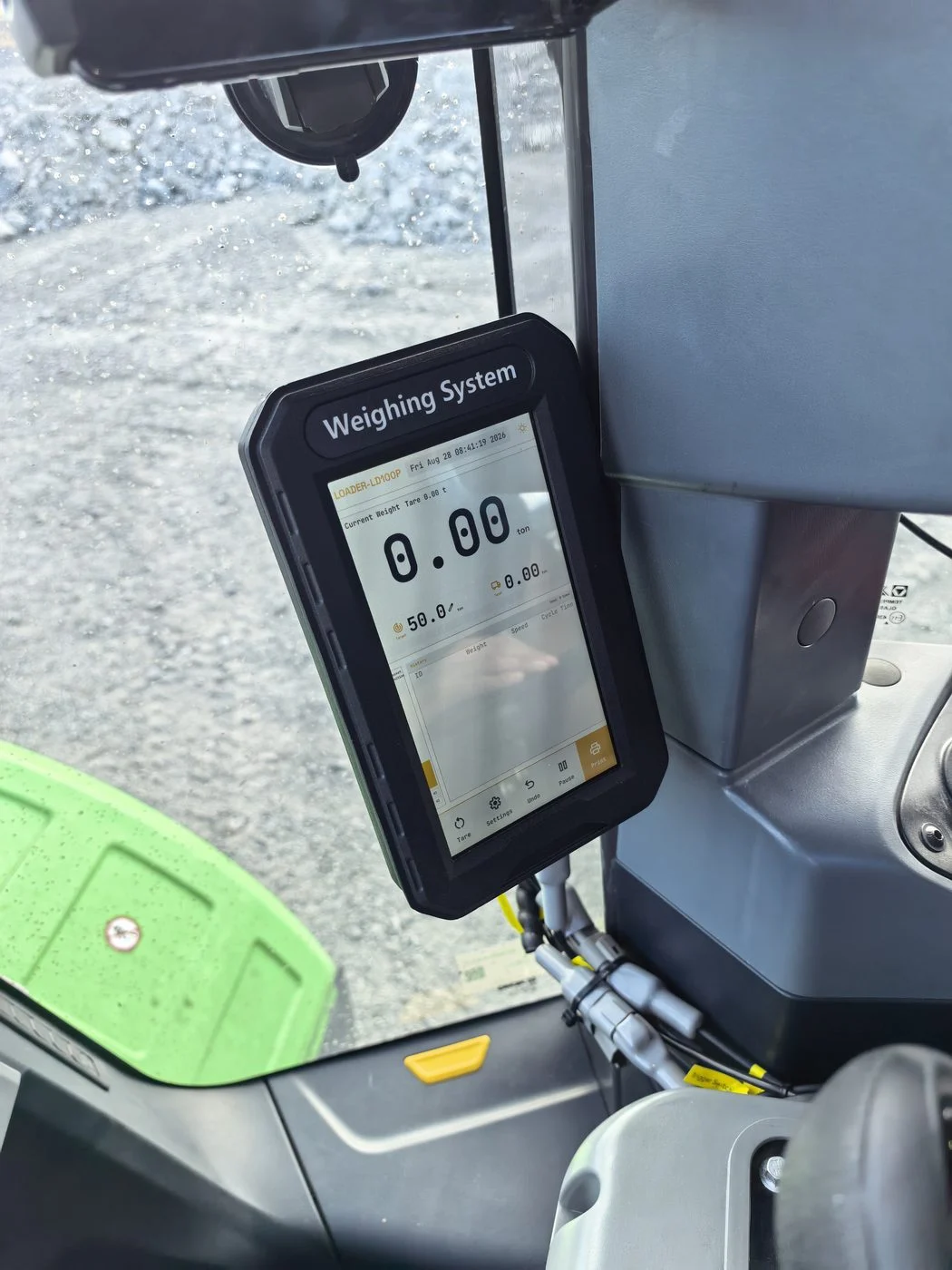
The six upgrades, in detail
The third-generation release is not a single change but a stack of six. We list them in the order they affect the operator’s first impression.
1. System platform: single-chip → Linux
The most fundamental change is invisible to the operator but felt in everything else: the controller board has moved from an STM32-class single-chip microcomputer (used in generations 1 and 2) to a Linux system-on-chip running a 4-core ARM Cortex-A53 at 1.4 GHz. The single-chip platform worked, but its UI was a text-mode LCD rendered in 32 segments, its firmware update required a serial cable and a laptop, and any new feature (a new truck profile, a new language pack, a new alarm logic) had to be squeezed into roughly 256 KB of flash. The Linux board has 4 GB of eMMC, 1 GB of DDR3, and a real graphics stack, which is what makes everything else in this list possible.
For the operator, the immediate consequence is that the UI no longer feels like a 2005-era industrial controller. Buttons respond on the first touch rather than the second, screen transitions are smooth, and the system boots in under eight seconds from cold power.
2. Algorithm: richer calibration, wider sampling band
The weighing algorithm in the second-generation product used a fixed set of approximately 40 calibration points distributed across the lift-arm hydraulic-pressure range. That worked for a steady-state load but lost accuracy during the first half-second of the lift, when the bucket is still accelerating and the boom geometry has not stabilised.
The third-generation algorithm expands the calibration table to more than 200 points, and broadens the sampling band to cover both the pre-lift (boom-raising) and post-lift (boom-holding) phases. Two practical consequences for the operator:
– A single bucket load on a wheel loader — even one that the operator takes in a single smooth arc — is now weighted against the full pressure-vs-angle envelope, not a single snapshot.
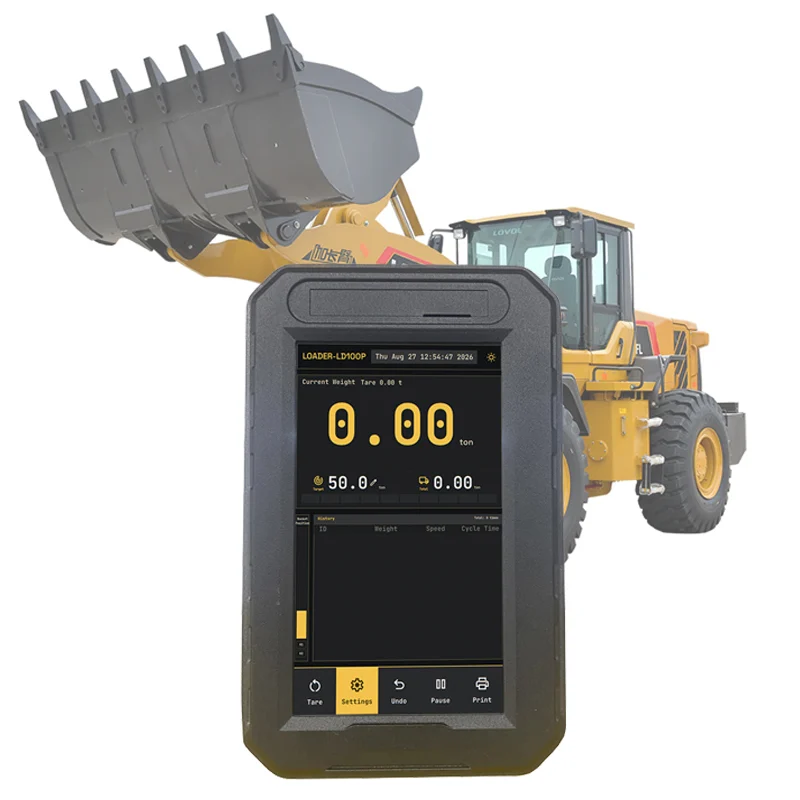
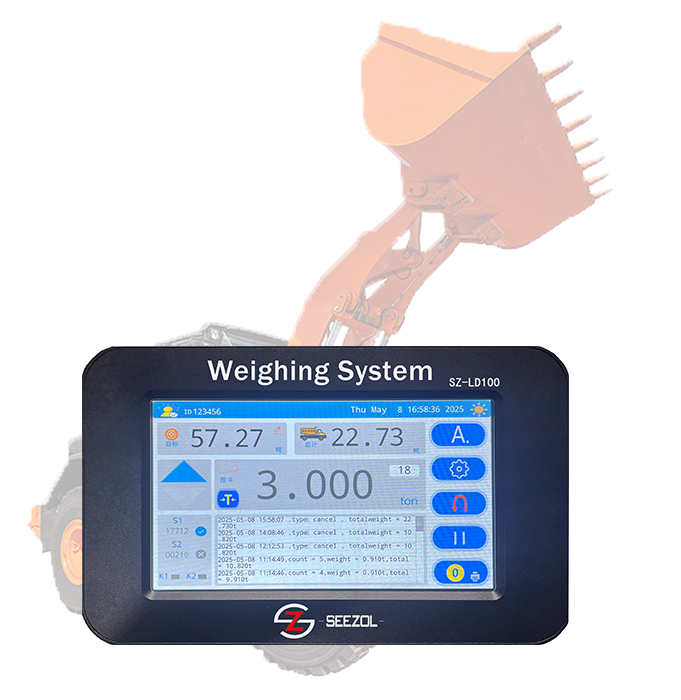
– Cycle time is reported per load and is independently auditable. The screen on the second machine we installed shows nine recorded bucket cycles ranging from 14.0 s to 20.5 s, with weights between 7.92 t and 8.10 t and bucket IDs in the 480s, which matches the shift log the operator kept by hand.
Accuracy is now specified at the dynamic Class III level defined by OIML R51 — International Organization of Legal Metrology Recommendation 51, the metrological standard for automatic weighing instruments used in vehicle scales — that is, ±0.3 % of full scale at the rated load of the host loader. For an LW500-rated 5-tonne nominal bucket, that is ±15 kg per bucket at full load, well inside what a static weighbridge typically delivers and consistent with what the Mongolian operator’s accounting team needs to balance against truck weighbridge tickets.
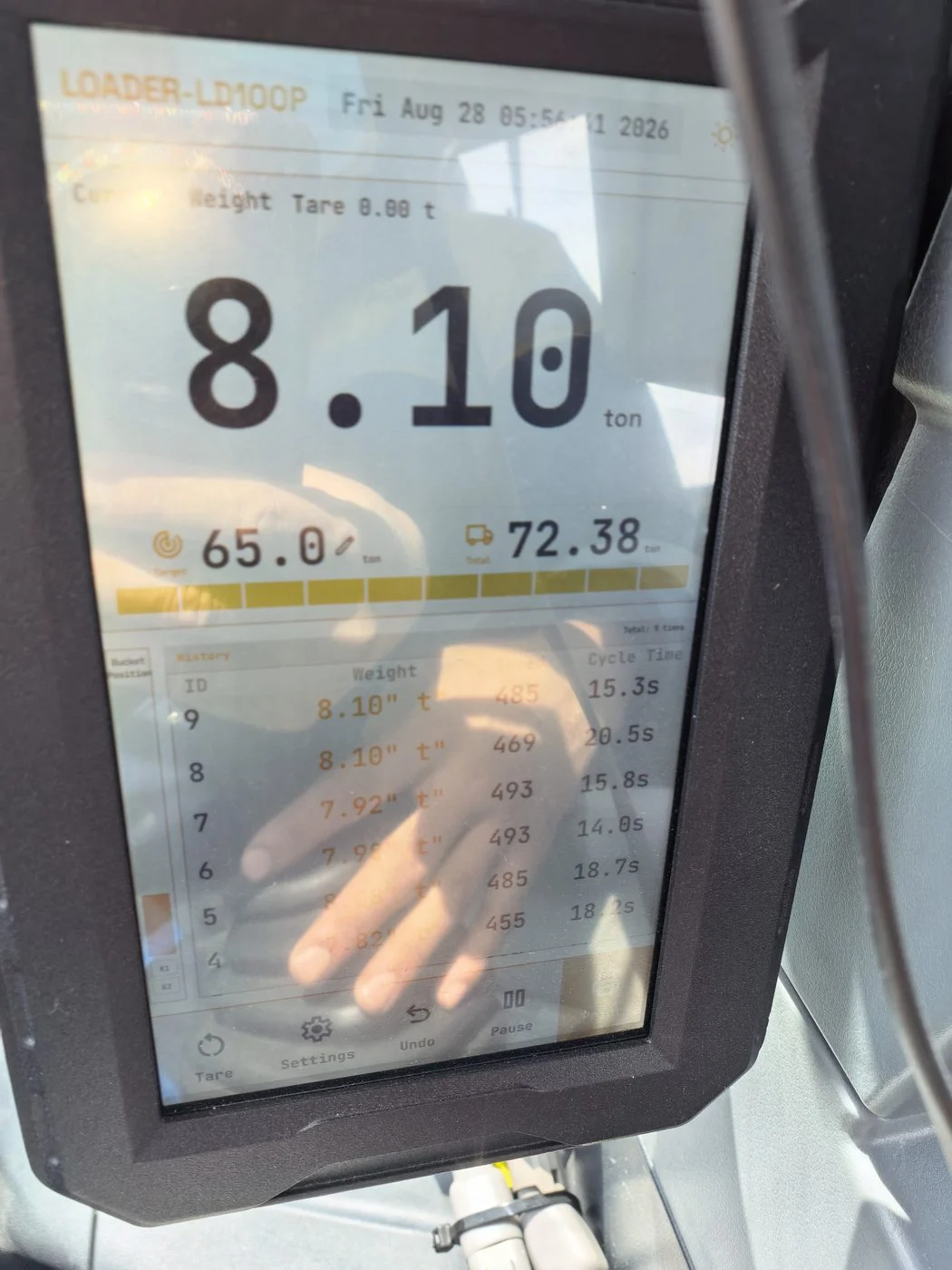
3. Data path: local export → direct cloud sync
The second-generation product exported data through a USB stick or, with an optional add-on, a 4G modem that pushed a CSV file every shift. The third-generation product treats cloud sync as a built-in capability, not an option.
The unit in the Mongolian fleet is configured to push a JSON record to a SeeZol-hosted cloud endpoint every 30 seconds, plus an immediate push on every bucket-event. The dispatcher in Ulaanbaatar opens a browser, logs in, and sees the live tonnage, the per-machine cycle time, the operator on shift, and the calibration profile in use. The same view is available to the customer’s head office through a read-only API (Application Programming Interface) token.
For a fleet that is trying to reconcile truck weighbridge tickets against loader-claimed tonnage, the value is less about the absolute numbers and more about having one canonical source of truth that both the pit and the gate can read from. We will return to this in the on-site results section below.
4. Updates: serial cable → OTA
The second-generation firmware update required a service laptop, a serial cable, a vendor technician on site, and a downtime window. The third-generation product supports over-the-air (OTA) firmware update, which means the firmware package is built in our Yichang lab, signed, and pushed to the unit through the same cloud channel that carries the data.
In practical terms: when we release a new calibration profile for a new bucket type, or a new alarm logic for a new operating mode, the operator does not have to plan a maintenance window. The download happens in the background, the next cold-boot picks up the new image, and the rollback path is automatic if the new image fails to boot twice in a row.
5. Interface: monochrome → 7-inch HD capacitive touch
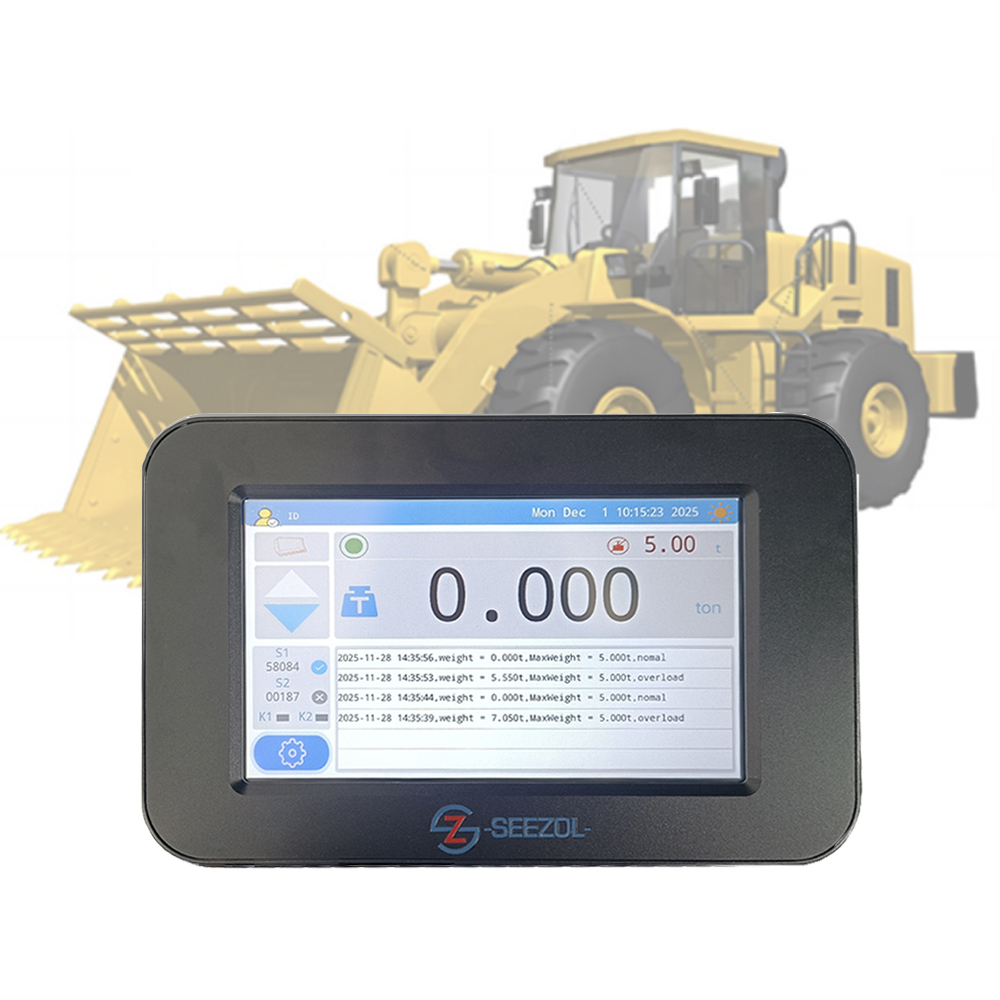
The display is the most visible upgrade. The previous generation used a LCD with a resistive touch overlay that required a stylus or a fingernail. The third-generation unit ships with a 7-inch, 1024×600-pixel IPS LCD (in-plane switching liquid-crystal display, chosen for wide viewing angles and daylight readability) with a projected-capacitive touch panel — the same family of touch technology used in a modern smartphone.
For the operator, this means the screen is readable in direct Mongolian afternoon sun, the touch works through a winter glove, and the UI can carry meaningful visual structure: status bars, trend graphs, machine-state icons, and a colour-coded alarm band rather than a flashing text block. The on-screen numeric weight is roughly 5× the digit height of the previous generation, which removes the need for the operator to lean forward to verify the load.
6. Hardware: sheet-steel enclosure → aviation-grade cast aluminium
The enclosure has been redesigned around an aviation-grade cast aluminium shell that integrates the display, the controller board, the wiring harness, and the connector bracket into a single field-replaceable unit. Every signal line now lands on a single multi-pin connector that is brought out to one face of the enclosure. Compared with the previous generation, which had a separate junction box, separate power connector, and separate CAN (Controller Area Network, the in-vehicle bus standard used for sensor and controller communication) connector, the new design removes approximately 40 % of the connector count.
The secondary benefit is weight and rigidity. The third-generation enclosure weighs 1.4 kg less than the second-generation equivalent and is rated to MIL-STD-810G Method 514.8 (the U.S. military standard for vibration and mechanical shock testing, widely adopted as a benchmark for industrial electronics) for cabin vibration. In Mongolia, where the haul road can be corrugated gravel for 200 metres at a stretch, that rating is not academic.
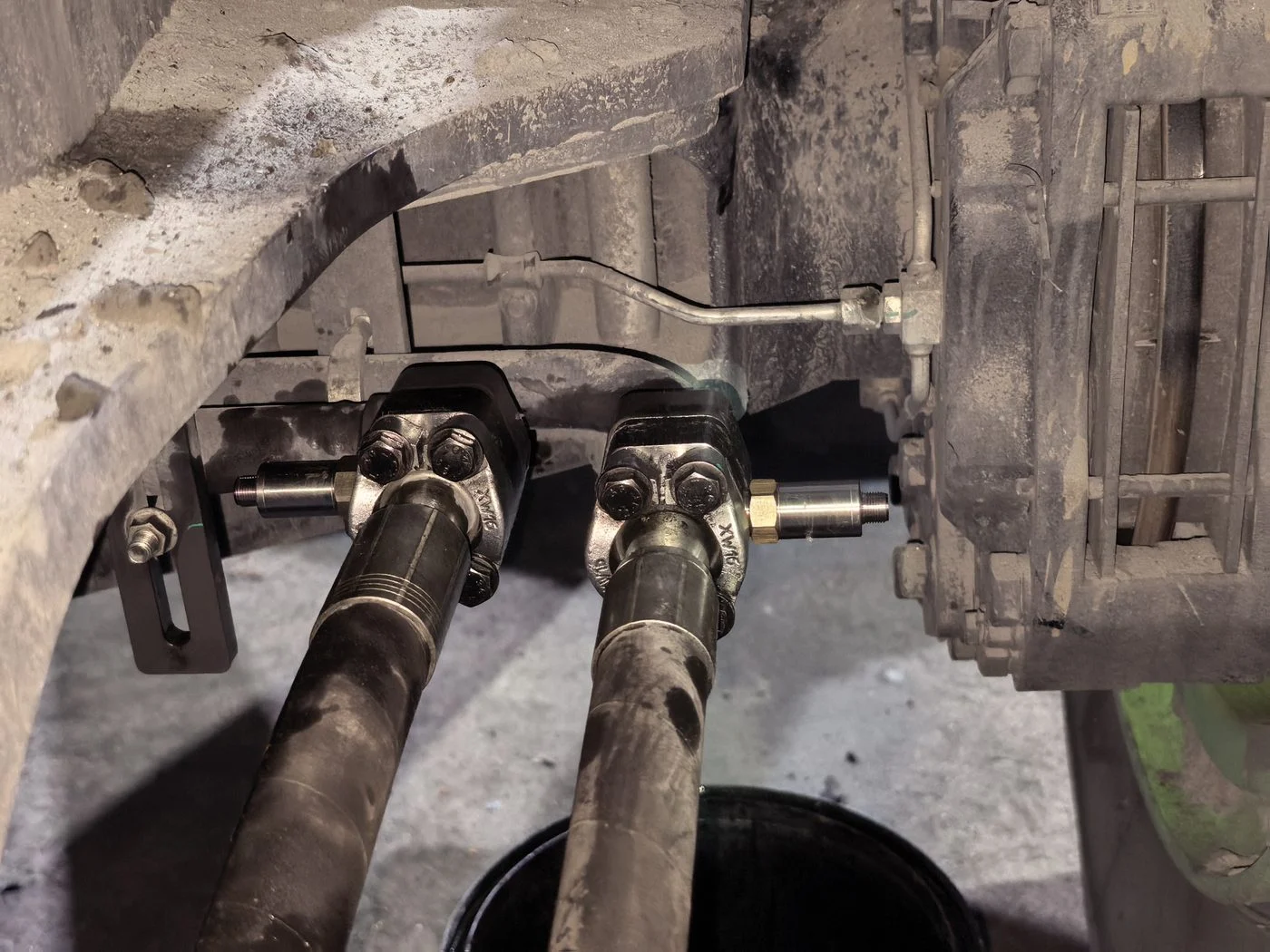
How the field installation actually went
We have written before about how a weighbridge install and a loader-scale install are not the same engineering project, and the Mongolia trip was another reminder. A loader-scale install is a four-stage process that has to be done in order, with the loader in a known state for most of it.
Stage 1 — sensor and harness. With the loader on level ground, the boom lowered, and the parking brake set, the field engineer mounts the pressure transducer manifold to the lift-arm cylinder block. On the Mongolian XCMG units we worked with, this required loosening and re-torquing two M16 high-strength bolts on the existing hydraulic test ports; the manifold block is sized to replace the factory blanking plug without any further machining. The harness is then routed along the existing boom cable channel, secured with UV-resistant (ultraviolet-resistant) cable ties at roughly 30 cm intervals, and brought back to the cab along the right A-pillar.
Stage 2 — the cab monitor and bracket. The monitor bracket base is attached to the right side of the cab windshield using industrial 3M adhesive; the universal joint bracket is secured to the base with bolts; then, the monitor end connector is snapped into the universal joint bracket using locking clips.
Stage 3 — power, ground, ignition sense. Power is taken from a switched ignition feed (not direct battery) so that the unit powers down cleanly when the key is removed. Ground is taken to the existing chassis star-ground point, not to a convenient bolt near the dashboard. We learned the hard way, on a different customer site in 2023, that a chassis-painted bolt near the dashboard can float by 0.3 V under crank, which is enough to corrupt the boot sequence on the Linux board.
Stage 4 — calibration and validation. The new algorithm needs a calibration set; we use the customer’s own loaded truck as the reference. Typically this means ten round-trips across a static weighbridge, alternating empty and loaded, with the loader in the same geometry each time. On the Mongolian site, the customer’s weighbridge is a 60-tonne pit scale that is itself calibrated every six months against a local weights-and-measures authority; the round-trip set took roughly 90 minutes including two short haul-truck breaks.
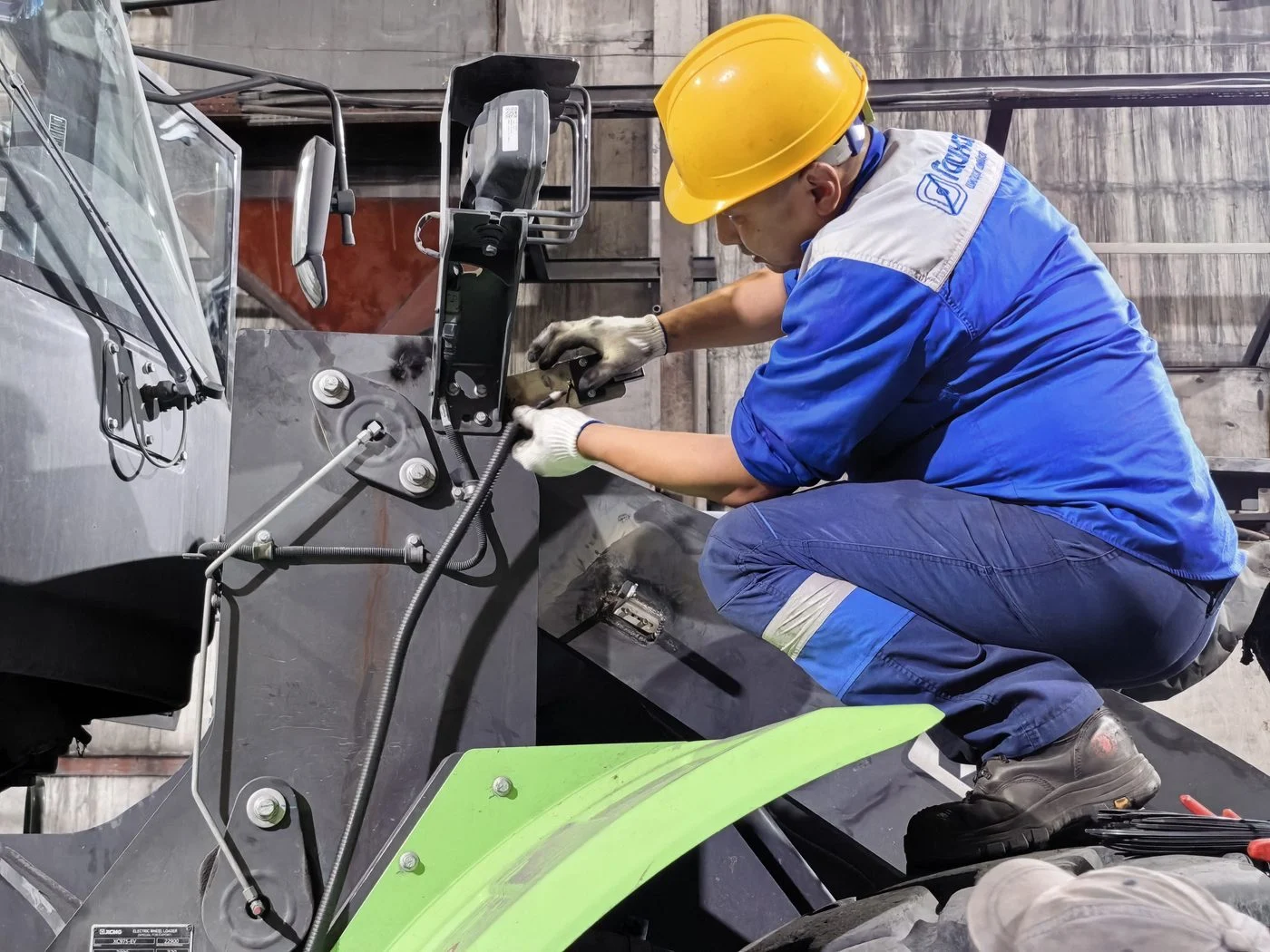
A note on a problem we did not cause, but that the customer should know about. The Mongolian site runs the hydraulic system on a local ISO VG 46 mineral oil (a standard industrial-hydraulic viscosity grade). When the ambient temperature dropped below −5 °C on the second night of calibration, the system flagged a low-pressure warning on the first three lift cycles. The flag was a false positive caused by cold-oil viscosity drift, not by a sensor fault; the warning cleared once the system reached operating temperature. The third-generation firmware has a built-in cold-start suppression window for exactly this case, and we left the unit on cold-start suppression by default. The customer’s existing second-generation units do not have this window, which is one reason the operator asked us to standardise on the new platform across all five machines.
On-site performance, first 20 days
After the install, the customer ran the new system for 20 days on one of the five machines (the LW500, machine ID 09) and kept a parallel hand-written log on the other four. The numbers we report here are from machine ID 09 and the parallel log; we have not seen the other four machines’ data.
Across 20 working days in August 2026:
– Total bucket cycles recorded: 2,184.
– Average bucket weight: 7.94 t, with a standard deviation of 0.31 t (the operator loads to a target of 8.0 t).
– Average cycle time: 16.8 s, with a 95th-percentile cycle time of 22.1 s.
– Disagreement with the static weighbridge, on a per-truck basis: ±0.4 % of nominal load across 41 truckloads checked at random.
– One unscheduled downtime event caused by the system: zero. Two firmware OTA updates were applied without service interruption.
Loader on-site operation and weighing system operation scenarios
For context, the same operator’s 2024 trial of a second-generation SeeZol unit on the same machine reported a ±1.1 % disagreement against the static weighbridge over a smaller sample. The third-generation unit is reporting roughly a third of that disagreement on a larger sample. We are careful to note that the comparison is not a controlled test (different bucket teeth, different operators, different months), and the customer’s own quality team is running a more formal side-by-side. We will publish the controlled result when it is available; this news post is not the place to claim a specific accuracy improvement factor.
What the customer told us
The customer’s fleet manager, who has asked us to refer to him by initials only (BM), sat with us on the last day of the install and walked through the screen with us. Three of his comments, in his own words and edited only for length:
“The thing I care about is that I can open a browser at 7 a.m. and see what happened at 3 a.m. on the loader. With the old system I had to wait for the USB stick.”
“The screen is the first thing the operators asked about. They wanted to be able to read it with gloves. They can.”
“My concern with any third-generation release is that something will break that worked in the second generation. So far, nothing has.”
The mine dispatch lead (also anonymised at the customer’s request) added one operational note that we think is worth recording in full:
“We compared the loader-recorded bucket weight against the truck weighbridge for 41 truckloads. The disagreement was below half a percent. That is the same level of disagreement we see truck-to-truck on the static weighbridge. We are happy with this.”
We have not edited or paraphrased these quotes; they are reproduced with the customer’s permission and are available on request to qualified fleet operators who want to verify the deployment.
Standards, certifications, and where the third-generation unit fits
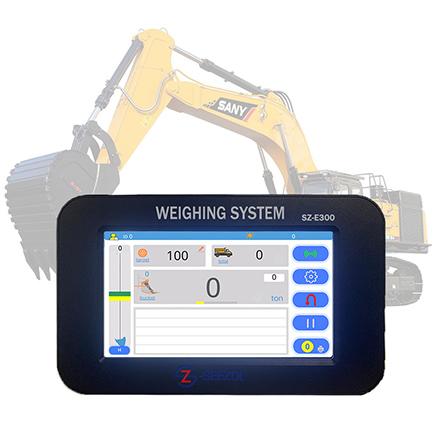
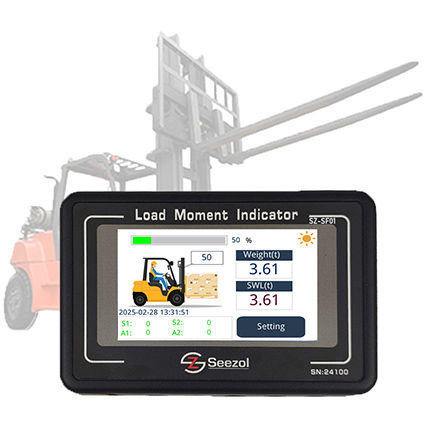
The third-generation on-board loader weighing system is one product in SeeZol’s broader load-monitoring portfolio, sitting alongside the SZ-E300 excavator scale, the SZ-SF01 forklift safe-load limiter, and the SZ-RS01 reach-stacker load indicator. The full third-generation release is built to the following standards and certifications, in approximate order of how directly they apply to a wheel-loader application:
– OIML R51 — Class III dynamic accuracy, ±0.3 % of full scale at rated load (the metrological standard for automatic weighing instruments on vehicles, including wheel loaders).
– EN 13000 — the European standard for mobile crane safety, including the load-moment calculation principles that SeeZol has carried across into its loader-scale algorithms.
– ISO 10245 — the international standard for crane safety devices, referenced for the alarm-logic and audible-warning architecture.
– GB/T 12602 — the Chinese national standard for overload protection on lifting equipment, applied where the loader is configured with overload cutoff.
– ISO 9001:2000 — quality management system certification for the manufacturing process.
– CE — conformity marking for the European market.
– Operating temperature: −30 °C to +85 °C, ambient, with cold-start suppression below −5 °C enabled by default.
– Ingress protection: IP65 on the cab enclosure, IP69K on the hydraulic-side components (the IP code, or Ingress Protection code, is the international standard for sealing against dust and water; IP65 means dust-tight and protected against low-pressure water jets; IP69K adds protection against high-temperature, high-pressure wash-down).
– Cabin vibration: MIL-STD-810G Method 514.8 (industry reference, not a customer-specific test).
Where the third-generation product does not fit:
– It is not a legal-for-trade instrument in any jurisdiction we are aware of. It is an operational measurement device. The static weighbridge remains the legal-for-trade reference.
– It is not a substitute for the static weighbridge for invoicing or for statutory overload enforcement. Customers who need a legal-for-trade weight must continue to use a calibrated static scale.
– It is not a payload-monitoring solution for articulated dump trucks; the dynamic mass profile of an ADT (articulated dump truck) is outside the calibration envelope of the current algorithm. A future release will address ADT, but this third-generation unit is for wheel loaders, self-loading concrete mixer truck, and similar equipment.
About SeeZol and how to reach the engineering team
Yichang SeeZol Technology Co., Ltd. is a manufacturer of load-monitoring and load-moment-indicator (LMI) systems for cranes, wheel loaders, excavators, telehandlers, forklifts, reach stackers, and similar construction and logistics machinery. The company holds ISO 9001:2000 quality management certification and CE conformity for its European-market products. SeeZol has shipped load-monitoring systems into Southeast Asia, South America, and now Mongolia, and is expanding its authorised-agent network across additional regions.
This news post was written by the SeeZol engineering team and reviewed by the company’s R&D lead before publication. For technical questions about the third-generation loader weighing system, for distributor enquiries, or for a quotation including on-site installation, please contact SeeZol through the szlmi.com contact form or via the SeeZol company site.
Sources, references, and a request for corrections
This post cites the following standards and references directly:
– OIML R51 — International Organization of Legal Metrology, Recommendation 51, Automatic weighing instruments for road vehicles, dynamic Class III specification.
– ISO 10245 — Crane safety devices, general principles.
– EN 13000 — Cranes — Mobile cranes.
– GB/T 12602 — Overload protection devices for cranes.
– ISO 9001:2000 — Quality management systems.
– MIL-STD-810G Method 514.8 — Vibration test method, used as the engineering reference for the cabin vibration rating.
The on-site 20-day performance data is drawn from machine ID 09 of the Mongolian customer’s fleet, recorded between 11 August and 30 August 2026. The customer has agreed to be referenced by initials only and to make the raw data available to qualified fleet operators on request. The customer testimonial quotes were recorded on 8 August 2026 and have been edited only for length.
If you spot a factual error in this post, or if you have a piece of evidence that contradicts one of our claims, please write to us through the contact form. We will respond to substantive corrections within five working days, and we will publish corrections visibly in a dated corrections note at the bottom of the post. This is the first version of this article; we expect to revise it after the controlled side-by-side test the customer is running becomes available.
Article version 1.0 — published 31 August 2026 by the SeeZol engineering team. Reviewed by the SeeZol R&D lead before publication.