
admin

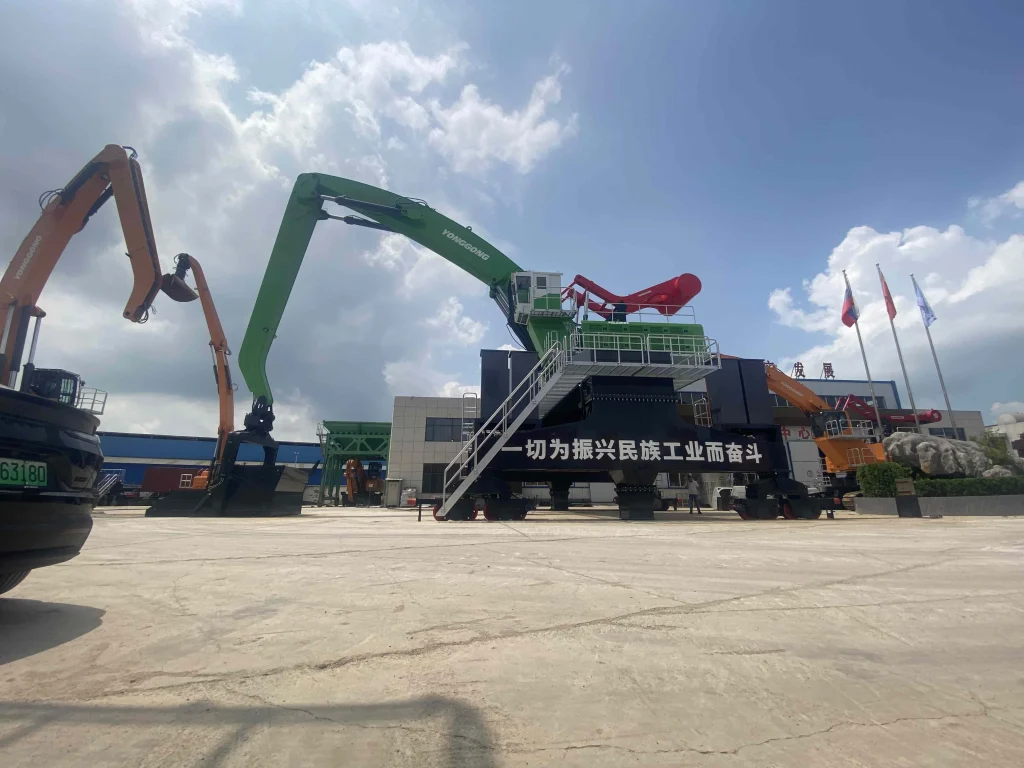
Mastering Heavy Machinery, Securing Safety: SeeZol Technology Empowers Huanghai Machinery’s 300-Ton Port Transfer hydraulic material handler with Advanced Safety Upgrades

SeeZol Technology has successfully partnered with Henan Huanghai Heavy Equipment Manufacturing Co., Ltd. to execute a critical safety upgrade on a 300-ton port transfer grab. Overcoming significant installation challenges posed by the equipment’s massive scale and 10-meter high pivot point, SeeZol’s team deployed a precision Load Moment Indicator (LMI) system. Rigorous testing with loads ranging from 5 to 20 tons confirmed the system’s ability to provide millisecond-level warnings and real-time monitoring across all operating positions. This project not only validates SeeZol’s technical expertise in extreme heavy machinery scenarios but also establishes a strategic foundation for future collaboration in digital and intelligent port safety solutions.

Mastering Heavy Machinery, Securing Safety: SeeZol Technology Empowers Huanghai Machinery’s 300-Ton Port Transfer hydraulic material handler with Advanced Safety Upgrades Read More »

Construction Machinery Safe Load Indicators (SLI): How They Work, Where They’re Used, and What to Look for When Buying

A practical guide to Safe Load Indicators (SLI) for construction machinery — covering how the sensor, control unit, display, and alarm components work together, why SLI and LMI (Load Moment Indicator) aren’t interchangeable, and where SLI actually gets used across warehousing, mining, construction, and port operations. Includes a buying checklist covering measurement accuracy, ingress protection, response time, and alarm logic, referenced against real OSHA and ANSI standards rather than vendor marketing claims. Field notes cover the most common failure pattern — silent sensor drift — plus a lesser-known “load center” blind spot rooted in basic tipping-moment physics. Ends with a buying-mistakes checklist and FAQ for anyone specifying SLI equipment for a mixed fleet.

Construction Machinery Safe Load Indicators (SLI): How They Work, Where They’re Used, and What to Look for When Buying Read More »

A Deep Dive into Crane Load Moment Indicators (LMI): Principles, Composition, and Applications

This article delves into Crane Load Moment Indicators (LMI). It’s a closed – loop safety system crucial for crane safety. The piece details LMI’s core components, working principle (including a worked example), and system classification. It also honestly assesses its value in preventing structural failure and supporting compliance, along with limitations like inability to detect bad rigging. Maintenance essentials, future trends, and FAQs are covered, providing a comprehensive understanding of LMI.

A Deep Dive into Crane Load Moment Indicators (LMI): Principles, Composition, and Applications Read More »

Load Moment Indicator: Industry Transformation from Traditional Single-Chip Microcomputer to IoT Edge Computing

Learn about the technical iteration of load moment indicator (LMI): from traditional single-chip microcomputer to CAN bus IoT edge computing system. Realize active crane risk warning & smart management for smart construction sites.

Load Moment Indicator: Industry Transformation from Traditional Single-Chip Microcomputer to IoT Edge Computing Read More »

(封面图或引言图) Operator's view inside crane cabin showing LMI display mounted on console

Under Extreme Climates: An In-depth Analysis of Full-Environment Protection for Load Moment Indicators and Safe Load Indicators on Cranes

From scorching deserts to frigid ice fields, and from high-salt-spray marine environments to industrial fields with strong electromagnetic interference, the extreme scenarios faced by cranes are becoming increasingly diverse, demanding higher reliability and stability from their safety devices.

Under Extreme Climates: An In-depth Analysis of Full-Environment Protection for Load Moment Indicators and Safe Load Indicators on Cranes Read More »

Onboard Weighing System vs Load Indicator vs Load Scale: Which Solves Your Fleet’s Weight Problem in 2026?

Quick Summary: Onboard weighing systems, load indicators, and load scales are three approaches to the same goal — knowing your truck’s weight in real time without stopping at a certified weigh station. Onboard weighing systems utilize load cells or air suspension sensors that are permanently integrated into trucks or various types of loading vehicles; load indicators

Onboard Weighing System vs Load Indicator vs Load Scale: Which Solves Your Fleet’s Weight Problem in 2026? Read More »

Contact Support

Fill out the form below, and we will be in touch shortly.