Autor: Revisado por el Departamento de Seguridad de Equipos de Elevación — elaborado con la colaboración de un integrador de sistemas de seguridad para grúas con experiencia práctica en la especificación y calibración de adaptaciones de LMI en grúas móviles y sobre orugas.
Publicado: 15 de junio de 2026 · Última revisión: 3 de julio de 2026
Aviso: No aceptamos pagos de proveedores de sistemas de seguridad para grúas con el fin de influir en las clasificaciones o recomendaciones que aquí se mencionan. Cuando se mencionan marcas concretas, es únicamente a título ilustrativo.
En resumen: en qué fijarse
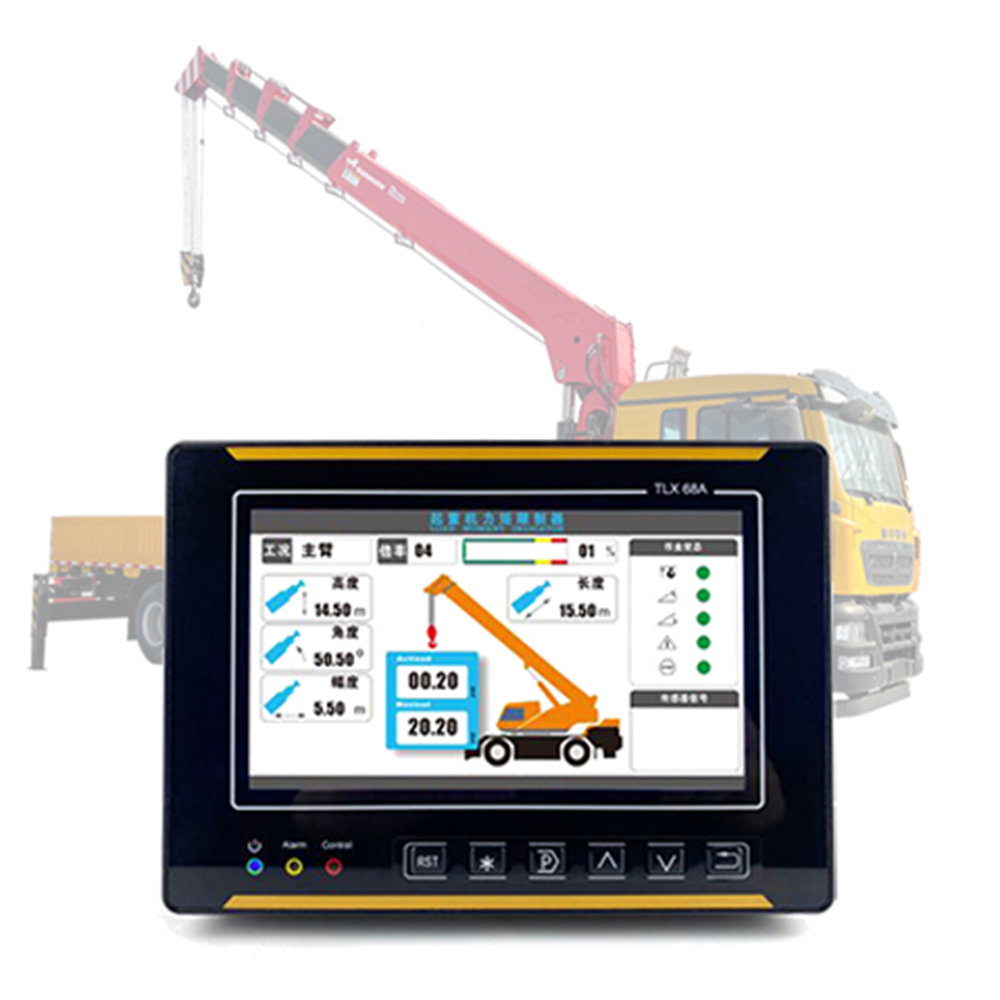
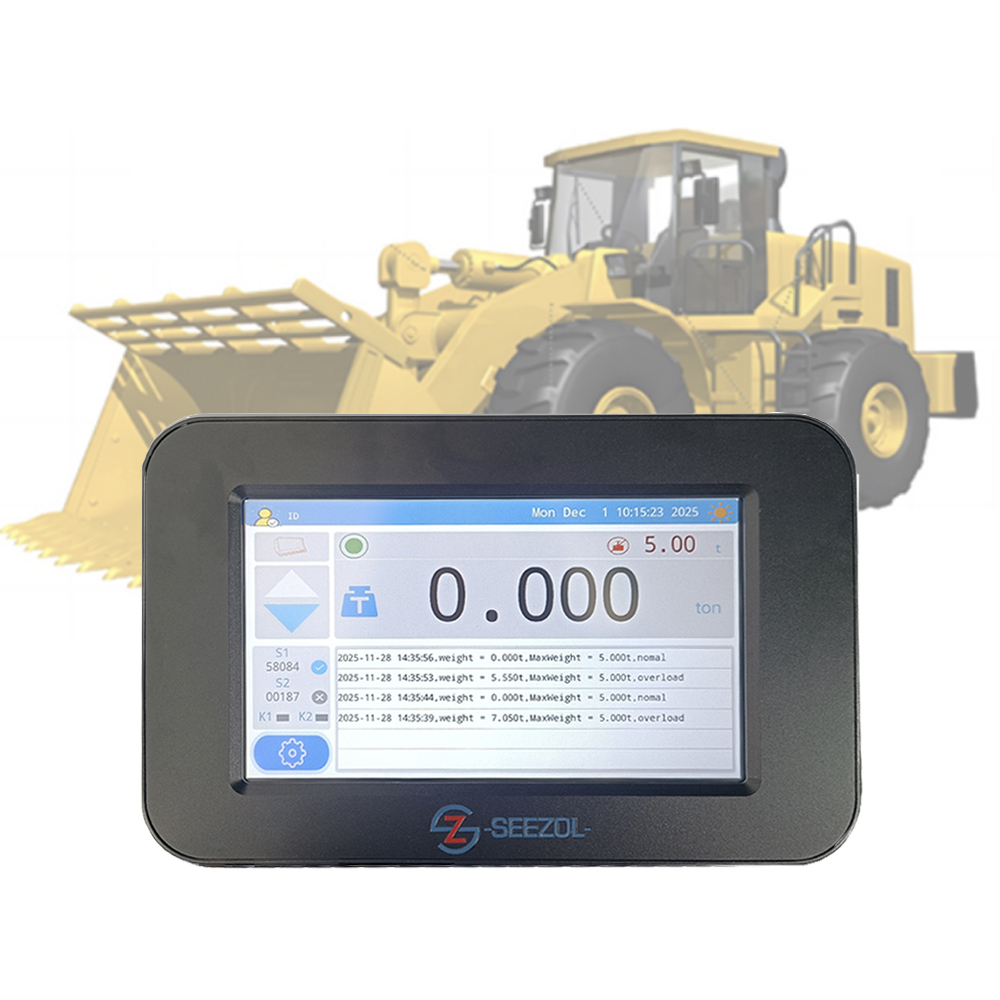
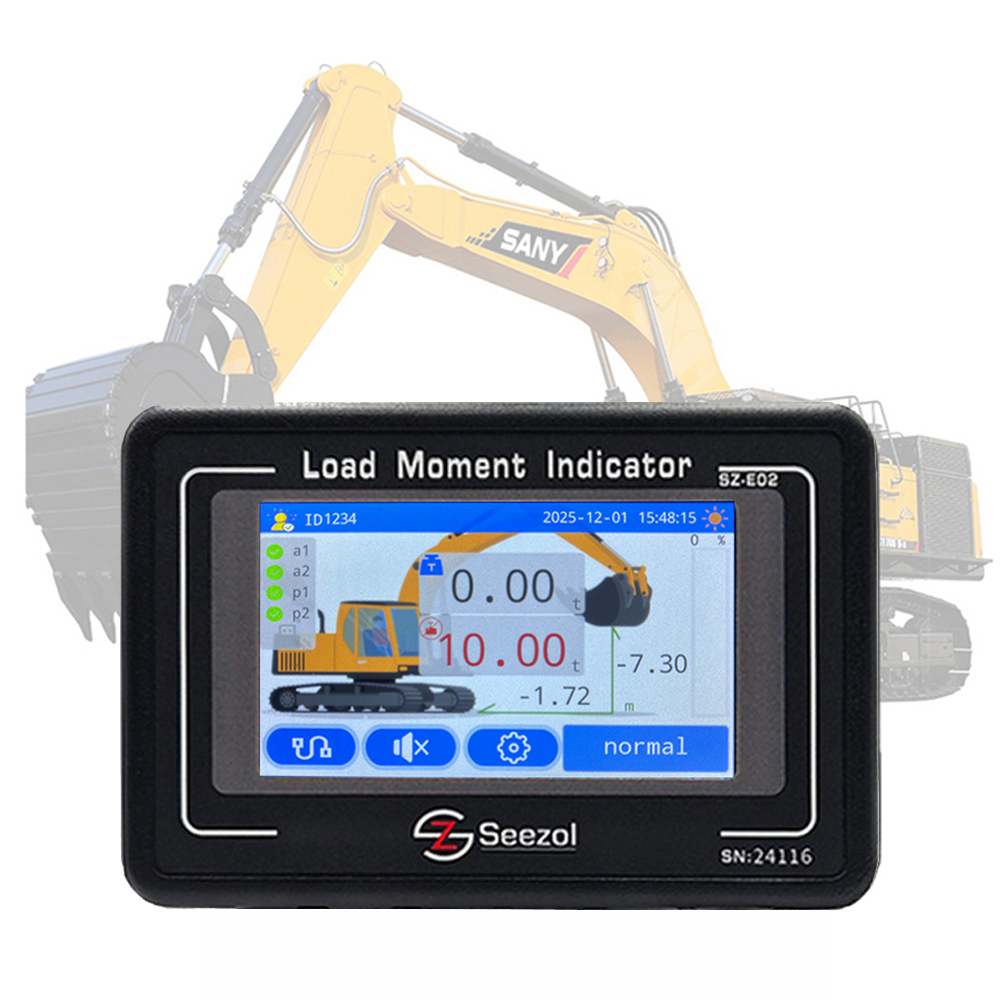
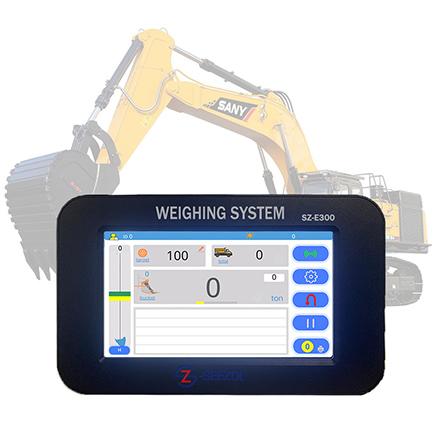
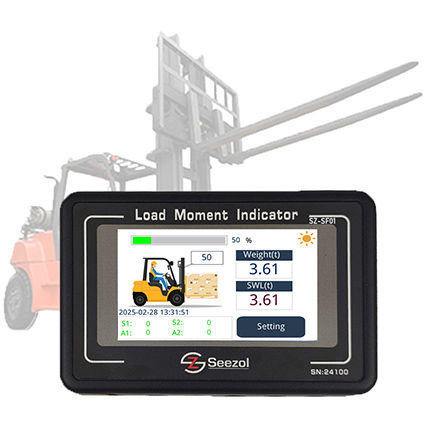
Un indicador de momento de carga (LMI) es un sistema de seguridad obligatorio para las grúas de pluma que impide que la grúa supere su momento de elevación nominal. A la hora de comparar sistemas, hay seis parámetros que determinan si un LMI es realmente de calidad industrial o si se trata simplemente de un producto de electrónica de consumo con otra marca:
| Paramètre | Nivel básico | De calidad industrial | Por qué es importante |
| Error de medición | ±5% | ±2–3% | Un error menor = menos falsas alarmas y menos sobrecargas no detectadas |
| 3. Tiempo de respuesta | No especificado / solo estático | ≤200 ms | Las cargas dinámicas (viento, balanceo, impacto) requieren una reacción en milisegundos. |
| Protección contra la entrada de elementos | Inferior a IP65 | IP65 o superior | Las instalaciones al aire libre necesitan carcasas herméticas al polvo y resistentes a las salpicaduras |
| Temperatura de funcionamiento | Rango reducido | De -20 °C a +60 °C | Debe resistir las condiciones más frías y más calientes de las obras en las que trabajes |
| Lógica de alarma | Umbral único | Niveles: 80–90% (advertencia), 100% (límite) | Una respuesta gradual evita las sobrecargas bruscas que provocan un apagado repentino. |
| Cumplimiento de las normas | Poco claro/no verificable | Conforme a las normas OSHA, ASME B30.5, EN 13001 o GB/T 12602 | Imprescindible para la inspección, el seguro y el uso en proyectos transfronterizos |
Si solo te quedas con una cosa: Comprar el LMI más barato que «pase la inspección sobre el papel» es un falso ahorro. — El fallo no consiste en una lectura ligeramente peor, sino en un falso negativo durante la única repetición en la que realmente importaba.
Índice
¿Qué es un indicador de momento de carga y qué no lo es?
Por qué es importante el LMI: la física de los fallos en las grúas
Precisión de las mediciones y tolerancia al error
Velocidad de respuesta y lógica de protección por niveles
Ajuste del rango de medición
Protección medioambiental y del hardware
Comunicación y registro de datos
Cumplimiento normativo por regiones
Notas de campo de un comprador: ¿qué es lo que realmente sale mal?
Errores habituales a la hora de comprar
Preguntas frecuentes
Acerca de esta guía
1. ¿Qué es un indicador de momento de carga y qué no lo es?
Indicador de momento de carga (LMI): Un sistema electrónico que calcula continuamente el peso de la carga multiplicado por el radio de trabajo y lo compara con la tabla de capacidad nominal de la grúa, activando alarmas por niveles y, en la mayoría de los sistemas modernos, un bloqueo automático a medida que la grúa se acerca a su límite.
Lo que no es: Un sensor de tensión de la línea de elevación de umbral único (que se asemeja más a un indicador de carga segura, o SLI) y que no sustituye a un aparejo correcto: un LMI supervisa la configuración de la grúa, no el estado de las eslingas ni el centro de gravedad de la carga.
Los sistemas LMI se denominan a veces «limitadores automáticos de momento» (AML) o «limitadores de capacidad nominal» (RCL), dependiendo del fabricante y la región; la terminología varía según el mercado, pero la función subyacente —evitar que la grúa funcione fuera de sus límites estructurales o de vuelco— es la misma.
2. Por qué es importante el LMI: la física de los fallos en las grúas
Las grúas rara vez fallan simplemente porque una carga sea «demasiado pesada»: fallan porque el momento de la carga (peso × radio) supera el límite estructural o de vuelco. Una carga de 10 toneladas con un radio de 5 m produce el mismo momento desestabilizador que una carga de 4 toneladas con un radio de 12,5 m. Sin un sistema de supervisión automatizado, el operador tiene que controlar mentalmente el ángulo de la pluma, el radio y la tabla de cargas en tiempo real, un proceso en el que es fácil cometer errores cuando se trabaja bajo presión o con mala visibilidad.
Por eso los organismos reguladores consideran que los dispositivos de control de carga son un requisito básico de seguridad y no un accesorio opcional. En Estados Unidos, la norma de la OSHA sobre grúas de construcción (29 CFR 1926.1417(o)(3)(ii)) exige a los operadores que no superen la capacidad nominal y señala los dispositivos de pesaje de carga, los indicadores de momento de carga y los indicadores de capacidad nominal como métodos aceptables para cumplir con la normativa. Un estudio de ingeniería revisado por pares sobre la prevención del vuelco de grúas (publicado a través de NCBI/PMC) señala igualmente que los investigadores federales de EE. UU. registraron 502en 479 incidentes durante un periodo de 11 años, de 1984 a 1994, lo que explica en parte por qué la limitación automática del momento de carga pasó a ser un aspecto regulatorio prioritario en lugar de un simple elemento «deseable».
3. Precisión de las mediciones y tolerancia al error
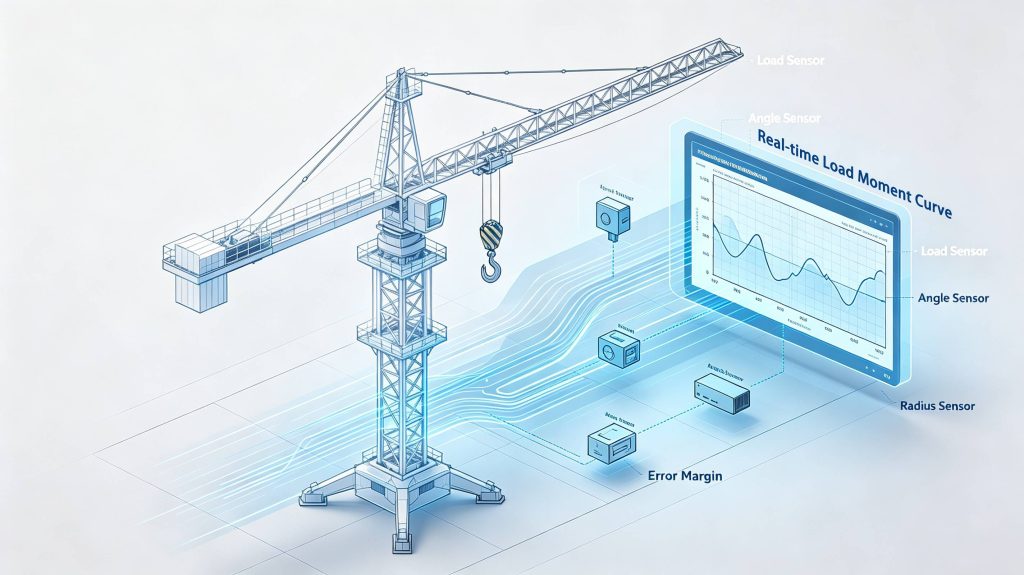
La precisión es el parámetro que más se suele pasar por alto en las fichas técnicas de los fabricantes, pero es el que determina si el sistema detecta una sobrecarga real o si da una falsa alarma en una elevación rutinaria.
- Dispositivos básicos Suelen tener una tolerancia de error de ±5%, lo que resulta suficiente para cumplir los requisitos básicos en entornos de bajo riesgo, pero son propensos tanto a falsas alarmas como a avisos tardíos en condiciones de radio variable y carga dinámica.
- De calidad industrial Los LMI suelen presentar un error de ±3% en todo el ámbito de trabajo.
- De alta precisión Los sistemas (utilizados en trabajos de carga pesada y en alta mar) alcanzan valores de ±2%.
Comprueba también el umbral de disparo por sobrecarga. La mayoría de los marcos normativos limitan el punto de alarma o bloqueo a 100–110% de la capacidad nominal, o a un valor cercano; un LMI bien calibrado debería dispararse en ese rango, en lugar de hacerlo antes (lo que provoca paradas indeseadas) o después (lo que reduce el margen de seguridad). Pide a los proveedores certificados de calibración de fábrica en los que figure el punto de disparo, y no solo afirmaciones publicitarias.
La protección dinámica contra las interferencias también es importante: las vibraciones mecánicas, las ráfagas de viento y los impactos durante la elevación provocan picos transitorios en los datos brutos de los sensores. Los sistemas que merecen la pena utilizan un filtrado dinámico para suavizar el ruido momentáneo sin ocultar una sobrecarga real y prolongada.
4. Velocidad de respuesta y lógica de protección por etapas
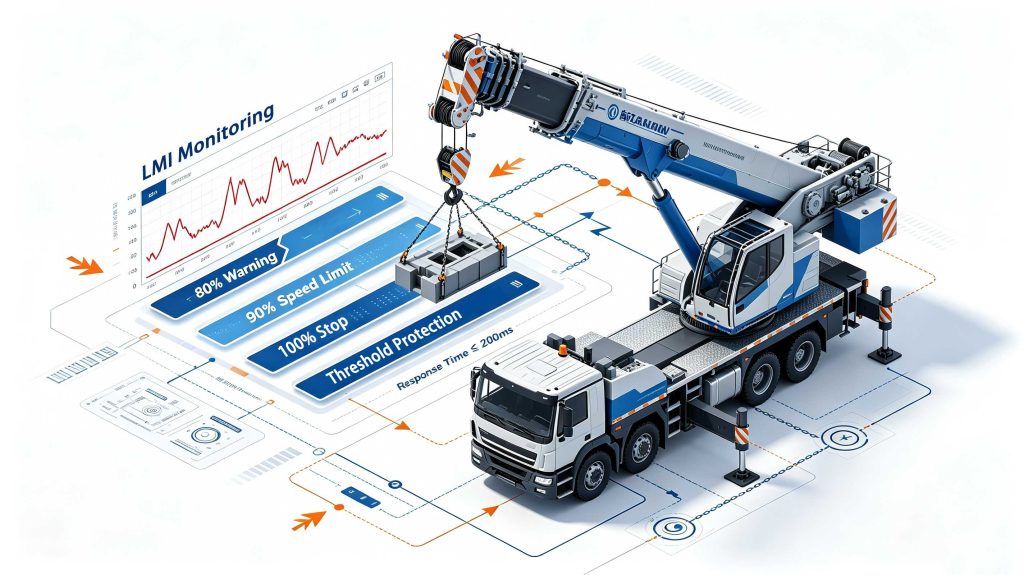
Las condiciones de carga de una grúa pueden cambiar en una fracción de segundo —durante el movimiento de elevación, una liberación repentina de la carga o ráfagas de viento—. La comprobación de la carga únicamente en condiciones estáticas (habitual en dispositivos económicos) pasa por alto por completo estos factores.
Qué hay que tener en cuenta:
- Tiempo de respuesta del sistema de ≤200 ms desde la entrada del sensor hasta la decisión de activación de la alarma o el bloqueo.
- Protección por etapas, sin ningún corte de encendido/apagado:
- ~80% de momento nominal → alerta temprana
- ~90% → limitación de velocidad o funcionamiento restringido
- 100%+ → bloqueo automático
- Filtrado inteligente con retardo que distingue entre una carga de impacto momentánea (por ejemplo, una ráfaga de viento) y una situación de peligro prolongada, de modo que la grúa no se detenga innecesariamente en mitad de la elevación.
Un corte brusco único en el límite parece más sencillo, pero en la práctica puede provocar oscilaciones repentinas de la carga o tensiones estructurales en la pluma precisamente cuando el operador más necesita una respuesta controlada.
5. Ajuste del rango de medición
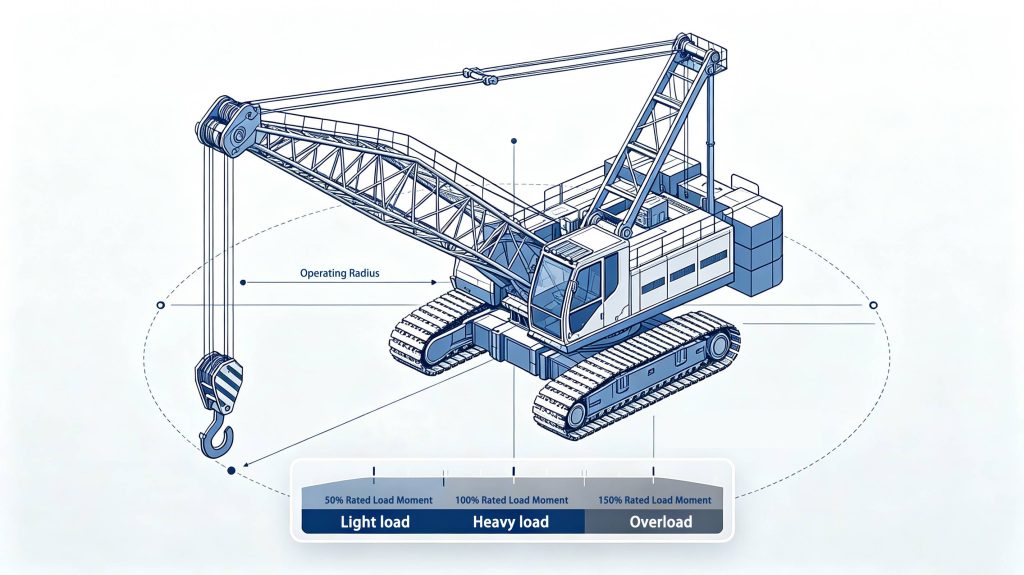
Los rangos de medición excesivamente amplios reducen la resolución con cargas ligeras; los rangos demasiado reducidos te dejan sin visibilidad en el límite superior de la capacidad de la grúa. Como regla general, un LMI adecuadamente adaptado debería cubrir aproximadamente entre 50 y 150% del momento de carga nominal de la grúa en toda su configuración de pluma, y no solo en una longitud de pluma concreta.
Busca recalibración in situ con un solo clic que se adapta automáticamente a los cambios en la altura de la pluma, el radio y el ángulo de inclinación, en lugar de requerir una visita de mantenimiento cada vez que cambia la configuración de la grúa. Esto es más importante que la cifra de alcance que aparece en los titulares, ya que la mayoría de las quejas sobre «desajuste de alcance» en la práctica se deben, en realidad, a fallos de recalibración tras un cambio de configuración.
6. Protección del medio ambiente y del hardware
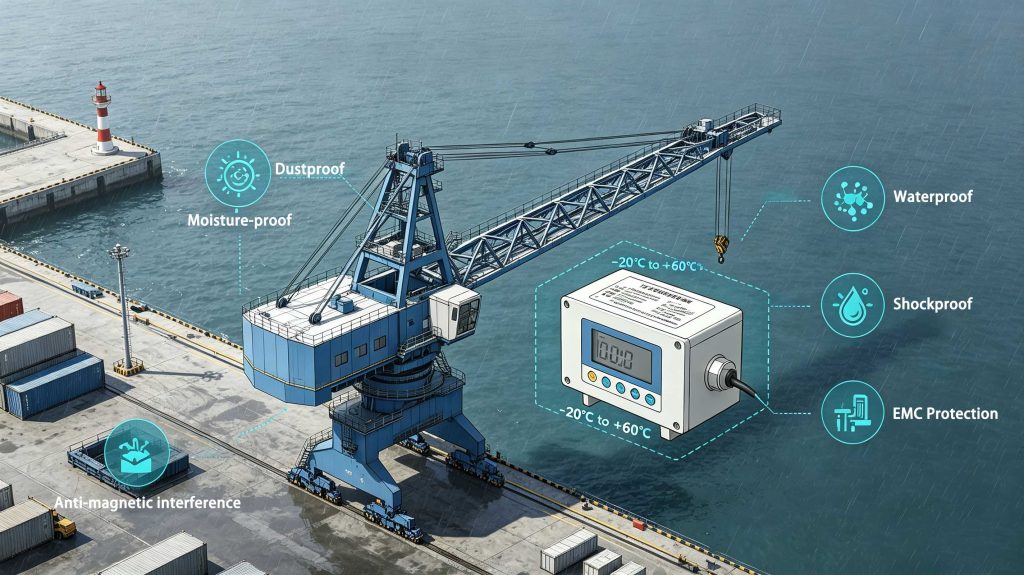
La mayoría de las grúas de exterior funcionan en condiciones para las que los componentes electrónicos no fueron diseñados, a menos que se consulte específicamente la ficha técnica de condiciones ambientales.
| Especificaciones | Mínimo aceptable | Notas |
| Protección contra la entrada de elementos | IP65 | Resistente al polvo y protegido contra los chorros de agua; por debajo de este nivel, cabe esperar corrosión del sensor y desviación de los circuitos en el plazo de 1 a 2 temporadas si se utiliza en exteriores. |
| Temperatura de funcionamiento | De -20 °C a +60 °C | Abarca la mayoría de los climas, desde los inviernos nórdicos hasta los veranos de la región del Golfo; compruébalo en función de tu ubicación concreta, no solo según la media regional. |
| Tolerancia a la humedad | ≤95% RH, sin condensación | Aplicable a zonas costeras y tropicales |
| Vibraciones/Compatibilidad electromagnética | Carcasa resistente a los golpes + diseño conforme a las normas de compatibilidad electromagnética (EMC) | Evita las falsas alarmas provocadas por equipos de soldadura, generadores o transmisores de radio cercanos en la obra |
Si tu grúa opera en un entorno verdaderamente extremo (ártico, desértico o costero con alta salinidad), solicita al proveedor informes de pruebas ambientales realizados por terceros, en lugar de fiarte únicamente en los datos de la ficha técnica; este es uno de los ámbitos en los que el discurso comercial y la realidad de los laboratorios suelen divergir con mayor frecuencia.
7. Comunicación y registro de datos
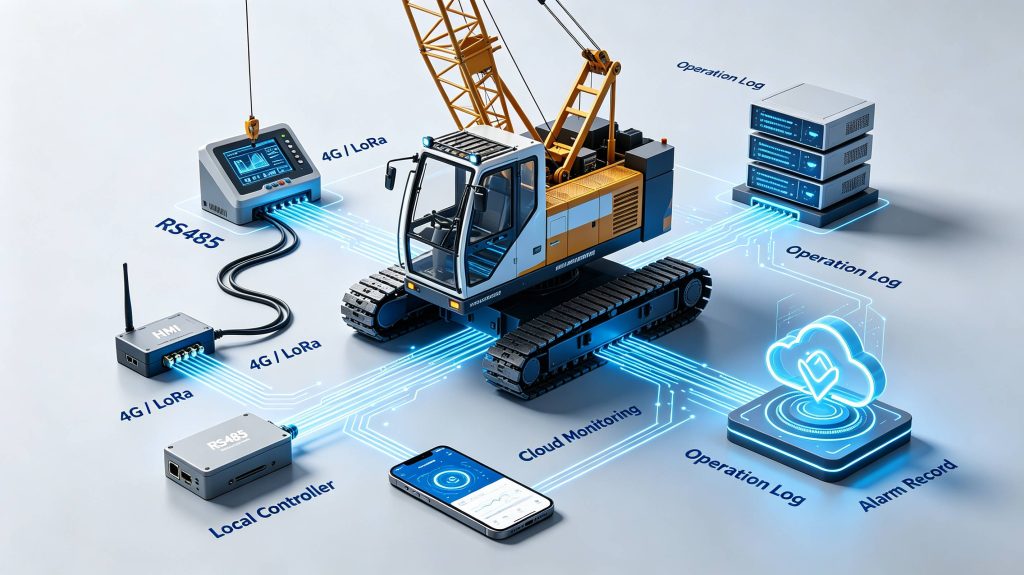
En las obras modernas se espera cada vez más poder consultar a distancia el estado de la grúa, y no solo a través de la pantalla de la cabina. Expectativas básicas para un LMI de última generación:
- Salida por cable RS485 de serie, para la integración con las pantallas de la cabina y la supervisión de la obra
- Módulos inalámbricos 4G o LoRa opcionales para la supervisión remota o en la nube de flotas distribuidas en múltiples emplazamientos
- Compatibilidad con doble tensión (220 V CA / 24 V CC), por lo que la adaptación no requiere volver a cablear el sistema eléctrico de la grúa
- El registro en el propio dispositivo del historial de carga y de los eventos de alarma: esto es cada vez más necesario para la documentación de cumplimiento normativo y la investigación posterior a los incidentes, y no es solo una función de comodidad.
8. Cumplimiento normativo por regiones
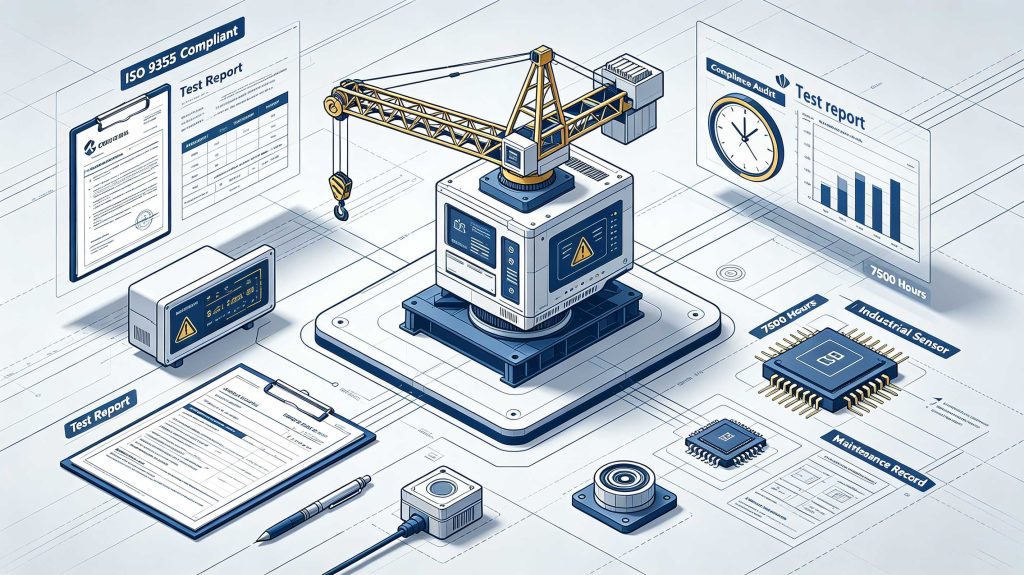
Los requisitos varían considerablemente según la jurisdicción, y la indicación «cumple con las normas internacionales» que figura en una ficha técnica no equivale a mencionar una norma concreta y verificable.
- Estados Unidos: La normativa de la OSHA sobre grúas de construcción (29 CFR 1926.1417(o)(3)(ii)) exige la instalación de dispositivos de control de carga en la mayoría de las configuraciones de grúas utilizadas en la construcción, y señala como métodos de cumplimiento aceptables los dispositivos de pesaje de carga, los indicadores de momento de carga y los indicadores de capacidad nominal. Las grúas torre tienen un requisito relacionado con un dispositivo limitador del momento de carga, según lo establecido en el artículo 29 CFR 1926.1435(e)(5)(v).
- Europa: La certificación de seguridad funcional de los sistemas de limitación del momento de carga en grúas móviles suele basarse en la norma ISO 13849 (seguridad de la maquinaria — partes de los sistemas de control relacionadas con la seguridad) y en la norma IEC 61508 / IEC 62061, además de la serie de normas EN 13001 sobre diseño de grúas, siendo el nivel de rendimiento d un objetivo habitual para las funciones de control orientadas a la seguridad implicadas.
- China: La norma GB/T 12602 es la norma nacional que regula los requisitos técnicos de los indicadores de momento de carga, incluyendo la precisión de los sensores, el tiempo de respuesta y la resistencia ambiental, y clasifica los sistemas según su grado de precisión.
Conclusión para el comprador: Pide a cualquier proveedor que te indique la norma y la cláusula concretas según las cuales está certificado su producto, y no te conformes con que te diga simplemente que «cumple con las normas internacionales de seguridad». Si no pueden facilitarte un número de certificado, considera que esa afirmación de conformidad no está verificada.
9. Notas de campo de un comprador: ¿qué es lo que realmente sale mal?
La mayoría de los fallos del LMI que hemos observado sobre el terreno no son fallos dramáticos del sistema, sino desviaciones silenciosas. Un patrón habitual: una grúa supera su inspección anual con un LMI correctamente calibrado y, seis meses después, el punto cero de la célula de carga se ha desviado un pequeño porcentaje debido a los cambios de temperatura y a las vibraciones. La pantalla sigue mostrando valores normales. El umbral de alarma no ha variado. Sin embargo, el punto de activación real se ha desplazado lo suficiente como para que una elevación límite que debería haber activado una advertencia no lo haga.
La solución no es una pantalla mejor, sino un hábito de mantenimiento: recalibrar el sistema tras cualquier reparación importante, tras seis meses de almacenamiento y, como mínimo, una vez al año, y conservar el certificado de calibración en el archivo, en lugar de confiar en que «no se ha encendido la luz» como prueba de que el sistema es preciso.
10. Errores habituales a la hora de comprar
- Comprar basándose únicamente en el precio. Un dispositivo ±5% y otro ±2% pueden parecer idénticos a simple vista en una ficha técnica; la diferencia solo se aprecia en la práctica, normalmente en el peor momento posible.
- No tener en cuenta el coste de la recalibración en el coste total de propiedad. La calibración anual, la sustitución de sensores y el tiempo de inactividad durante el mantenimiento deben tenerse en cuenta a la hora de tomar la decisión de compra, y no ser una cuestión secundaria.
- Confiar en que «cumple con las normas internacionales» sin un número de certificado. Vale la pena repetirlo: es la afirmación imprecisa más habitual en esta categoría de productos.
- Para ser justos con los sistemas más económicos: No todas las aplicaciones requieren el máximo grado de precisión. Una grúa que realiza elevaciones ligeras, repetitivas y muy por debajo de su capacidad en un entorno interior controlado presenta un perfil de riesgo realmente diferente al de una grúa móvil que realiza elevaciones al aire libre con radios variables y cerca de su capacidad máxima; y pagar por una precisión propia de aplicaciones en alta mar en el primer caso es, en sí mismo, un despilfarro. Adapta las especificaciones al riesgo real, no a la cifra más alta que figure en la ficha técnica.
11. Preguntas frecuentes
¿Cuál es el índice de protección IP mínimo para una grúa LMI de exterior?
El grado de protección IP65 es el mínimo práctico para un uso continuo en exteriores. Por debajo de ese nivel, cabe esperar un deterioro acelerado de los sensores y los circuitos debido al polvo y la humedad, especialmente en entornos costeros o con alta humedad.
¿Con qué frecuencia hay que recalibrar un LMI?
Al menos una vez cada 12 meses y, además, tras cualquier reparación importante, sustitución de sensores, incidente relacionado con una sobrecarga o un impacto, o un almacenamiento prolongado (más de 6 meses).
¿Un índice de precisión más alto siempre significa un mejor LMI?
No necesariamente. La precisión es fundamental en el caso de las grúas que funcionan cerca de su capacidad máxima con radios variables. Para operaciones de elevación ligeras, muy por debajo de la capacidad máxima y con una configuración fija, un dispositivo de precisión de gama media, combinado con una buena disciplina de calibración, puede resultar totalmente adecuado; véase la sección «errores comunes» más arriba.
¿Puede un LMI compensar un mal montaje?
No. Un LMI supervisa el momento de carga de la grúa, no el aparejo. Pueden darse ángulos incorrectos en las eslingas, herrajes dañados o una carga inestable, incluso aunque el LMI indique una situación «segura».
¿Qué norma debería pedirle a un proveedor que certifique?
En EE. UU., pregunta por el cumplimiento de los requisitos de la OSHA relativos a los sistemas de ayuda a la operación de grúas y, cuando proceda, de la norma ASME B30.5. En la UE, solicite la documentación sobre seguridad funcional conforme a las normas ISO 13849, IEC 61508 o 62061, junto con la norma EN 13001. En China, solicite la clasificación del grado de precisión según la norma GB/T 12602.
12. Acerca de esta guía
Normas editoriales: Las afirmaciones técnicas que figuran en esta guía se han contrastado con la normativa disponible públicamente y con la documentación de los fabricantes y del sector en el momento de su redacción. Cuando se presenta una cifra concreta (tolerancia de precisión, tiempo de respuesta, índice de protección IP) como referencia del sector, en lugar de como afirmación de un único proveedor, hemos intentado señalar esa distinción en lugar de presentar la ficha técnica de un producto como norma universal.
Correcciones: Si detectas alguna inexactitud, sobre todo en relación con una cláusula normativa concreta, te rogamos que la señales; esta guía se considera un documento en constante evolución y se corregirá y se volverá a fechar, sin que se realicen modificaciones de forma silenciosa.
Contacto: Si tienes alguna corrección o pregunta sobre esta guía, ponte en contacto con la redacción en safety-editorial@[dominio-de-tu-empresa].com (sustituye por tu dirección de contacto real antes de publicar).
Fuentes consultadas
- OSHA 29 CFR 1926 — Grúas y torres de perforación en la construcción, secciones sobre ayudas operativas y cumplimiento de los límites de peso de carga (a través de la base de datos de textos normativos de up.codes)
- Kim et al., «Limitador de par económico para prevenir la sobrecarga en grúas móviles de carga», publicación de ingeniería revisada por pares (PMC/NCBI), en la que se citan datos federales de EE. UU. sobre incidentes con grúas entre 1984 y 1994
- Documentación técnica de WIKA Mobile Control sobre las normas de seguridad funcional (ISO 13849, IEC 61508/62061) para sistemas de limitación del momento de carga
- Resúmenes de las normas de las series GB/T 12602 y EN 13001 (consulte a su organismo regional de normalización para obtener el texto completo oficial)
Este artículo es una versión reescrita de una guía anterior, reestructurada para añadir referencias bibliográficas, una declaración de transparencia, consejos de compra por etapas y equilibrados, una nota sobre las normas editoriales y un formato de preguntas frecuentes y comparativas, de acuerdo con una auditoría de calidad de contenidos realizada por CORE-EEAT.