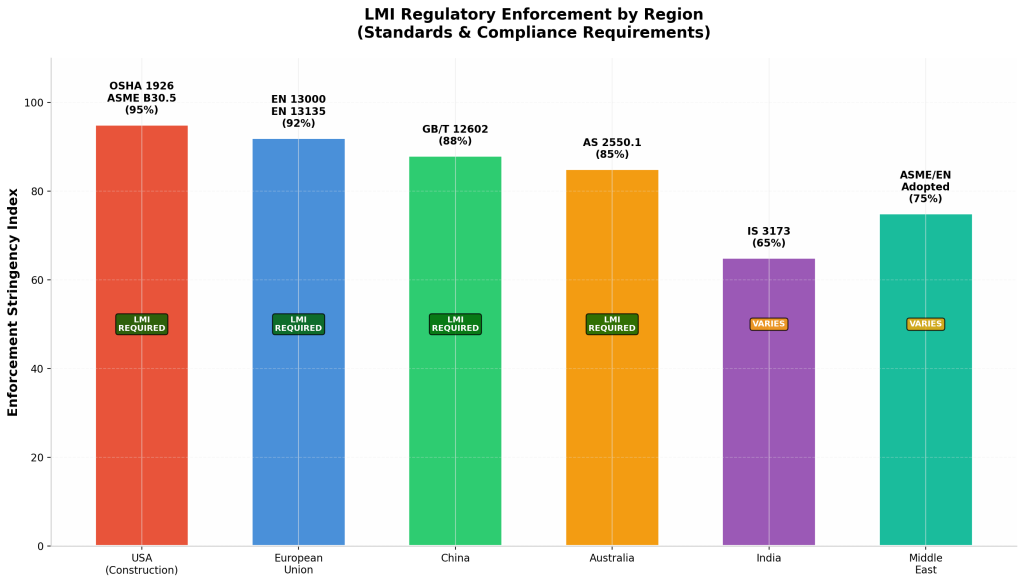
Impulsionado por requisitos regulamentares não obrigatórios cada vez mais rigorosos e por normas de segurança nas principais economias, o mercado global de indicadores de momento de carga para gruas está a experimentar oportunidades significativas e crescentes. À medida que avançamos para 2026, a aplicação das normas de segurança para gruas passou de "recomendação" para "cumprimento obrigatório".
Nos Estados Unidos, a norma 29 CFR 1926, Subparte CC, da OSHA, exige que a maioria dos guindastes móveis esteja equipada com dispositivos de monitorização de carga. Entretanto, a norma EN 13000 da UE estipula que todos os tipos de guindastes móveis com uma capacidade de elevação nominal superior a 1.000 kg, fabricados a partir de 2010, devem ser equipados com indicadores de carga nominal. A norma nacional chinesa GB/T12602-2020 estabelece requisitos técnicos detalhados para dispositivos de proteção contra sobrecarga, incluindo a definição de limites de alarme entre 90% e 95% da carga nominal e a obrigatoriedade de instalação de sistemas de alerta visual e sonoro. Estes requisitos regulamentares estão a criar uma procura constante e inevitável por sistemas de monitorização de carga.
1. Dinâmica de crescimento do indicador global de momento de carga e distribuição regional do mercado
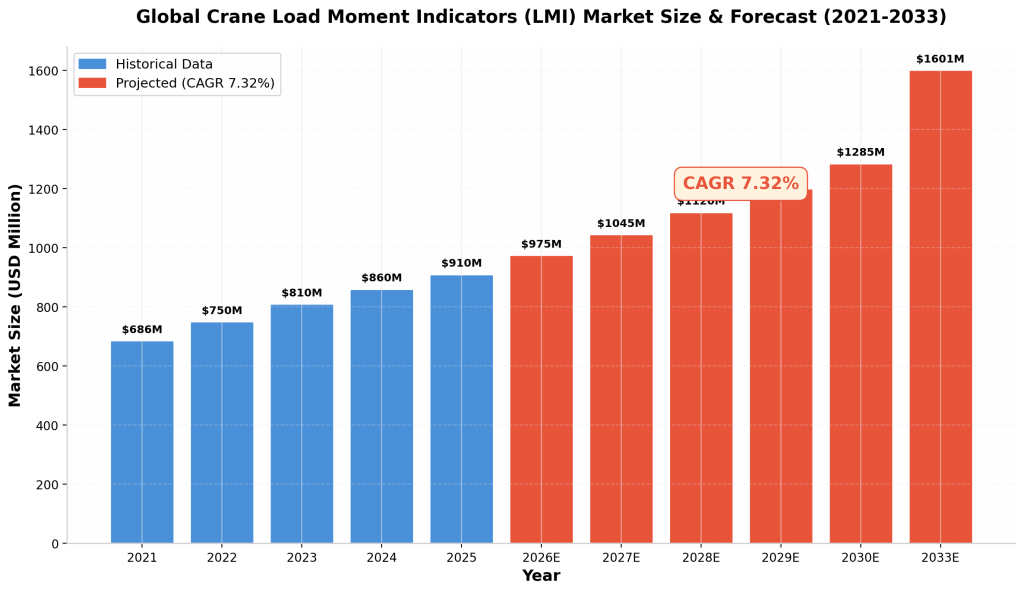
O mercado global de indicadores de momento de carga para gruas tem demonstrado um crescimento consistente na última década, impulsionado pelo aperto regulamentar, pelos investimentos em infraestruturas e pelos avanços tecnológicos. De acordo com a Cognitive Market Research, o mercado foi avaliado em 685,69 milhões de dólares em 2021 e a projeção é que atinja os 909,6 milhões de dólares até 2025, representando uma taxa de crescimento anual composta (CAGR) de aproximadamente 7,32%. Até 2033, os analistas do setor projetam que o mercado ultrapasse os 1,6 mil milhões de dólares.
Tamanho e previsão do mercado global de indicadores de momento de carga (LMI) para gruas (2021-2033)
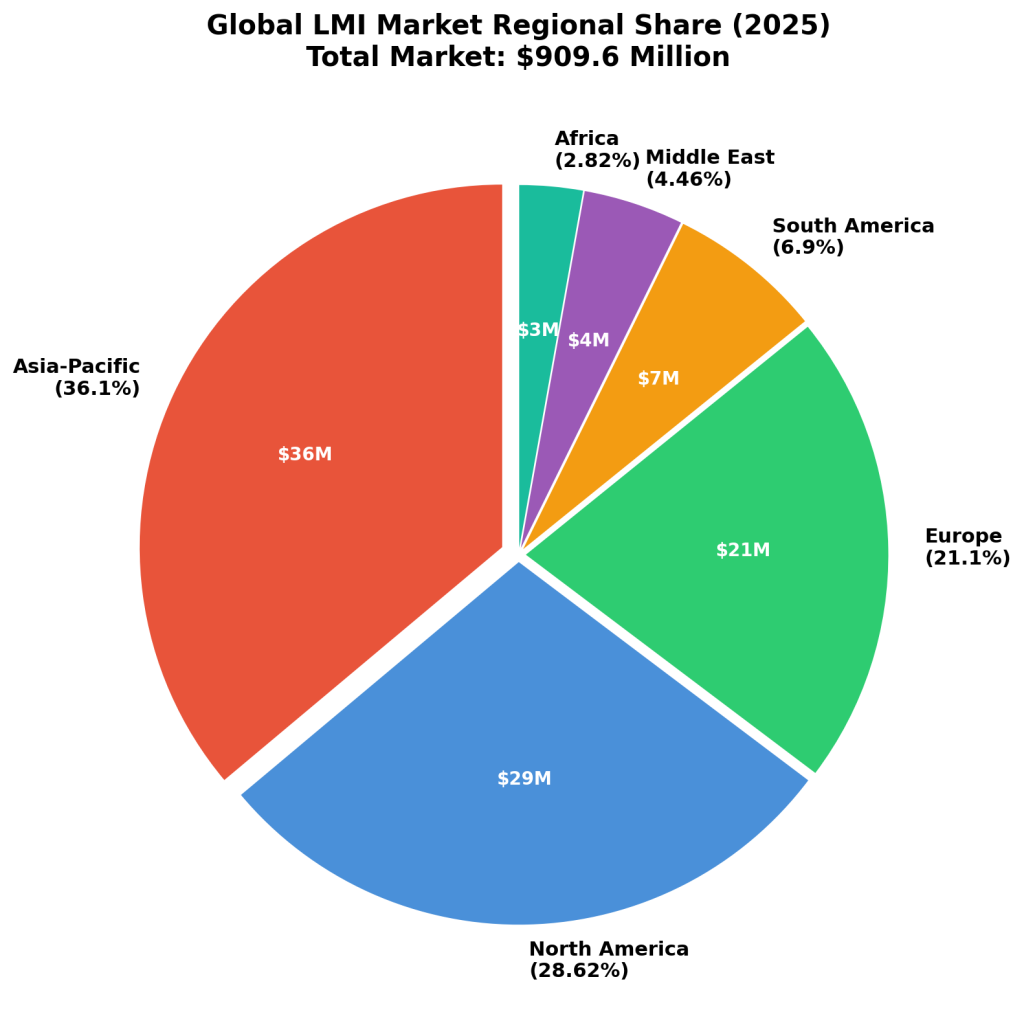
O mercado global de LMI apresenta características regionais distintas, influenciadas por diferentes níveis de maturidade regulamentar, ritmo de desenvolvimento da infraestrutura e cultura de segurança da indústria.
2. Normas e Quadros Regulamentares Internacionais
| Caraterística | UE (EN 13000) | EUA (ASME B30.5) | China (GB/T 12602-2020) |
|---|---|---|---|
| Limiar de disparo | 90% (Visual/Áudio) | 90-100% (Depende da configuração) | 90% – 95% (Visual/Áudio) |
| Ponto de corte | 100% (Zona Vermelha) | 100% (Bloqueio automático) | 100% (Bloqueio automático) |
| Tipo de visor | Analógico + Digital | Leitura digital | Digital (Vídeo/Áudio Duplo) |
| Sensores principais | Raio, Ângulo, Carga | Carga, Raio, Capacidade nominal % | Carga, Raio, Ângulo, Altura |
2.1 Normas e Diretivas da UE
A União Europeia implementou a estrutura regulamentar mais abrangente do mundo para a segurança das gruas, centrada na Diretiva 2006/42/CE sobre máquinas e normas harmonizadas de produtos. Especificamente, o artigo 1.3.7 aborda os “riscos decorrentes das operações de elevação” e exige que as máquinas equipadas com dispositivos de elevação sejam concebidas de forma a garantir que as cargas não possam deslizar perigosamente ou cair inesperadamente. O artigo 1.5.13 estipula que as máquinas de elevação devem estar equipadas com “medidas para evitar sobrecargas”.
EN 13000:2004 — Gruas — Gruas móveis
A norma EN 13000 é a norma principal para gruas móveis na União Europeia. A secção 4.2.6.3.7 (com requisitos obrigatórios) estipula que todos os guindastes móveis com capacidade de elevação nominal igual ou superior a 1.000 kg ou com momento de tombamento igual ou superior a 40.000 newton-metros devem estar equipados com os seguintes dispositivos:
- Um visor analógico contínuo que indica a taxa de utilização da capacidade de elevação nominal, acompanhado de indicadores de estado codificados por cores (verde para funcionamento seguro, amarelo para aproximação da capacidade de elevação nominal e vermelho para condições de sobrecarga);
- Para gruas com capacidade de elevação superior a 5 toneladas, o raio de trabalho/comprimento da lança também deve ser apresentado;
- Exibição da carga real, incluindo o peso do conjunto do bloco de gancho;
- Dependendo da situação específica, podem ser fornecidos indicadores adicionais para o ângulo da lança, comprimento da lança, velocidade do vento, alcance de rotação e estado de bloqueio do eixo.
A norma EN 13000 estipula ainda (Secção 4.2.6.2.2) que todos os componentes dos dispositivos de limite e indicação relacionados com a segurança devem estar em conformidade com a Categoria 1 (para sistemas mecânicos) ou a Categoria 2 (para dispositivos de avaliação eletrónica), conforme especificado na norma EN 954-1:1996. Isto significa que os sistemas LMI devem demonstrar a sua clara integridade de segurança através de capacidades de deteção de falhas.
EN 13849-1 — Segurança das máquinas
Para os sistemas LMI que utilizam dispositivos eletrónicos programáveis, a norma EN 13849-1 define os níveis de desempenho (PL a a PL e) para os sistemas de controlo relacionados com a segurança. Os sistemas LMI avançados equipados com função de bloqueio automático devem atingir, no mínimo, o nível PL d (alta integridade de segurança) para satisfazer as expectativas europeias para funções críticas de segurança em máquinas.
2.2 Normas e Regulamentos dos EUA
A estrutura regulamentar de segurança de gruas dos EUA combina as normas da Administração de Segurança e Saúde no Trabalho (OSHA) com as normas de consenso da indústria desenvolvidas pela Sociedade Americana de Engenheiros Mecânicos (ASME), criando um ambiente de conformidade com múltiplas camadas que está a impulsionar o crescimento contínuo da procura de soluções de LMI (Infraestrutura de Manuseamento de Carga).
OSHA 29 CFR 1926 Subparte CC
As normas da Administração de Segurança e Saúde no Trabalho (OSHA) para gruas de construção, totalmente implementadas desde novembro de 2010, representam a regulamentação federal mais significativa que influencia a procura de Indicadores de Monitorização de Carga (LMIs) nos Estados Unidos. As principais disposições destas normas incluem: a Secção 1926.1412(d)(1), que estipula que os operadores não devem exceder a capacidade nominal do guindaste; e a Secção 1926.1412(d)(2), que exige que os guindastes estejam equipados com tabelas de carga ou dispositivos que forneçam informações equivalentes. Embora a OSHA não exija explicitamente marcas ou tipos específicos de sistemas LMI, os requisitos práticos têm impulsionado eficazmente a incorporação de recursos de monitorização de carga nos guindastes para garantir operações seguras.
ASME B30.5-2021 — Gruas Móveis e de Locomotivas
A norma ASME B30.5 é a norma de consenso da indústria mais frequentemente citada nos procedimentos de conformidade com a OSHA. A secção 5-1.9.10.2 refere explicitamente: “Todos os guindastes com uma capacidade máxima de elevação nominal de 3 toneladas ou mais devem estar equipados com um indicador de carga, um indicador de carga nominal ou um limitador de carga nominal (ou de carga)”. Este requisito obrigatório aplica-se a gruas de rastos, gruas de camião, gruas de rodas, gruas de locomotivas, gruas todo-terreno e gruas fora de estrada.
A norma ASME B30.5 estipula que o indicador de carga (LMI) deve exibir o peso da carga, o ângulo da lança, o raio e a percentagem da capacidade nominal. Quando o alarme é acionado, a carga não deve exceder 100% da capacidade nominal, e os sistemas equipados com bloqueio automático devem ser capazes de bloquear automaticamente assim que a capacidade nominal for atingida ou excedida. Além disso, esta norma exige a instalação de dispositivos anti-gancho duplo, indicadores de ângulo/raio da lança e indicadores de nivelamento da grua.
2.3 Norma Nacional da República Popular da China
A China estabeleceu uma estrutura regulamentar robusta para as máquinas de elevação. A norma nacional GB/T 12602-2020, emitida pela Administração Estatal de Regulação do Mercado, serve de base para a proteção contra sobrecarga no maior mercado de construção do mundo. A norma nacional chinesa para dispositivos de proteção contra sobrecarga representa uma das estruturas regulamentares mais rigorosas do mundo, gerando uma procura interna significativa e, ao mesmo tempo, fornecendo um parâmetro de conformidade para os mercados de exportação.
GB/T12602-2020 — Dispositivos de segurança contra sobrecarga para máquinas de elevação
Esta norma nacional, emitida pela Administração Estatal de Regulação do Mercado e implementada em 1 de outubro de 2020, revê a GB/T12602-2009 e expande significativamente os seus requisitos técnicos. A norma aplica-se aos dispositivos de proteção contra sobrecarga — incluindo os sistemas LMI — utilizados em talhas elétricas, pontes rolantes, pórticos rolantes, gruas móveis, gruas de torre e gruas de braço.
Requisitos técnicos principais
- Condições ambientaisO equipamento deverá operar normalmente numa gama de temperaturas de -20℃ a +60℃, com humidade relativa de 90% a 20℃ e altitude não superior a 2.000 metros.
- Limiares de alarmeQuando a carga atingir entre 90% e 95% da capacidade de elevação nominal, serão accionados alarmes visuais e/ou sonoros. Quando a carga atingir 100% da capacidade nominal, serão ativados alarmes visuais e sonoros duplos. O nível de pressão sonora do alarme sonoro não deverá ser inferior a 75 dB(A) a uma distância de 1 metro da fonte sonora.
- Precisão do visorNo ponto de atuação, o erro de indicação do peso da carga deve situar-se entre 0% e +5%; para ângulos da lança ≥ 65 graus, o erro de indicação do ângulo da lança deve estar entre 0 e -2 graus; o erro de indicação do comprimento da lança deve estar entre 0% e +2%.
- Durabilidade e InterfaceO dispositivo deverá completar 1.000 ciclos de carga consecutivos sob carga nominal sem degradação do desempenho. Deverá estar equipado com uma interface de saída de comunicação que suporte protocolos abertos para registo de dados.
2.4 Norma Internacional (ISO/IEC)
Las normas internacionales desarrolladas por ISO e IEC proporcionan la base técnica para las regulaciones en países de todo el mundo.
ISO 8686-1:2012 — Gruas — Princípios de projeto para cargas e combinações de cargas
A norma ISO 8686-1 é uma norma internacional fundamental para o projeto de gruas, especificando os tipos de cargas (carga permanente, carga de elevação, carga dinâmica, carga de vento e carga de ensaio), bem como as combinações de carga utilizadas para a verificação estrutural. O método de combinação de cargas estipulado nesta norma determina diretamente as tabelas de capacidade nominal referenciadas pelo sistema LMI durante o funcionamento.
IEC 61508 — Segurança Funcional
Para sistemas LMI que utilizam controladores de software, a norma IEC 61508 fornece uma estrutura para atingir níveis de integridade de segurança específicos (SIL 1 a SIL 4). Na maioria das aplicações LMI em gruas, o objetivo é o nível SIL 2 (com um fator de redução de risco que varia entre 100 a 1.000), um nível apropriado para prevenir condições de sobrecarga, dado que uma falha nestes casos representaria um risco significativo de ferimentos graves ou morte. Em termos de métricas quantitativas, a probabilidade média de falha a pedido (PFDavg) para o SIL 1 varia de 10⁻² a 10⁻¹, enquanto que para o SIL 4, a probabilidade média de falha a pedido situa-se no intervalo de 10⁻⁵ a 10⁻⁴.
IEC 60204-1:2018 — Equipamentos eletromecânicos
A norma IEC 60204-1 especifica os requisitos de segurança elétrica para máquinas, incluindo circuitos de controlo, funções de paragem de emergência e compatibilidade eletromagnética. Os sistemas LMI devem cumprir os requisitos de tensão, as normas de isolamento e os níveis de imunidade à compatibilidade eletromagnética.
2.5 Outras normas nacionais e regionais
O Regulamento de Operações de Elevação e Equipamentos de Elevação do Reino Unido (LOLER 1998) estipula que os equipamentos de elevação devem “possuir resistência e estabilidade suficientes para suportar com segurança cada tipo de carga” e devem “indicar claramente a carga de trabalho segura”. A Secção 7(b) exige ainda que, quando a carga de trabalho segura varia com o raio de funcionamento, o equipamento deve estar equipado com um “indicador de capacidade nominal e um limitador de capacidade nominal”. As diretrizes da Agência Executiva de Saúde e Segurança (HSE) referem explicitamente que as gruas móveis, as gruas de torre e as pás carregadoras montadas em camiões se enquadram na categoria de equipamentos cuja carga de trabalho segura varia consoante a sua configuração — o que, na prática, exige a instalação de um sistema de indicador de carga (LMI).
Na Austrália, a norma AS 2550.1:2011 exige que os guindastes móveis e os guindastes de torre estejam equipados com indicadores de capacidade nominal.
Na Índia, as normas IS 3177:2020 e IS 4573:2022 estão gradualmente a alinhar-se com as normas ISO e EN; entre elas, a instalação do LMI (Low-Speed Movement Inspector) é obrigatória para gruas de torre e gruas móveis de grande porte.
No Médio Oriente, as jurisdições adotam geralmente as normas ASME ou EN para projetos de construção, particularmente em projetos que envolvem empreiteiros internacionais.
3. Resumo
O ambiente regulamentar para os equipamentos de segurança de gruas a nível global cria procura e oportunidades de mercado. Compreender estes requisitos regulamentares é crucial para o desenvolvimento de estratégias de conteúdo orientadas para os mercados internacionais.
Enquanto a UE enfatiza as diretivas de máquinas e as zonas de segurança codificadas por cores, os EUA baseiam-se numa combinação de regulamentos da OSHA e normas de consenso da ASME. No entanto, a norma chinesa GB/T 12602-2020 estabelece requisitos técnicos rigorosos para a adaptabilidade ambiental. Apesar das diferenças regionais, a tendência global é clara: a integração de sistemas LMI inteligentes deixou de ser opcional e passou a ser um requisito obrigatório para a operação segura e em conformidade de gruas em todo o mundo.